
Can Gallstones Disappear Without Surgery? What Actually Works
- Home
- Hernia Care
- Can Gallstones Disappear Without Surgery? What Actually Works
Can Gallstones Disappear Without Surgery? What Actually Works

Written & Medically Reviewed By:
Dr. Mangesh Yadav
General, Laparoscopic & Robotic Surgeon
15+ Years of Surgical Experience
6,000+ Piles Cases Treated
Table of Contents
Sometimes, yes. But only for a narrow group of patients, and even then the stones can come back.
Most people searching for gallstones without surgery fall into one of three groups. They fear surgery, have been told their stones are small, or have read that a juice flush will clear everything out. This guide sorts what clinical sources support from what they don’t.
Overview
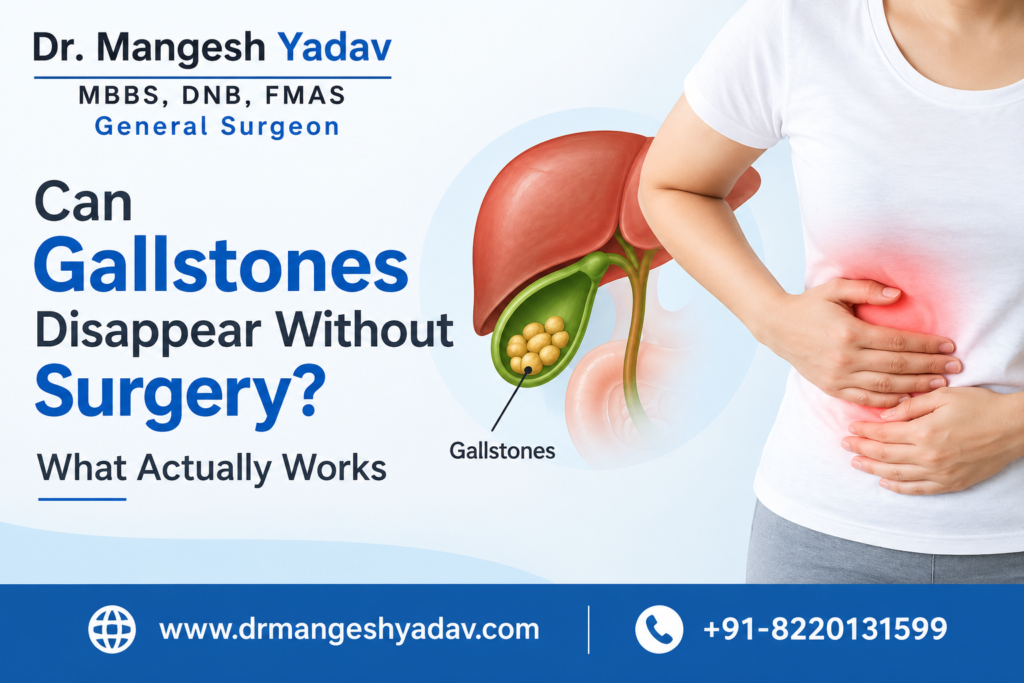
Gallstones usually do not disappear on their own. Medicines may dissolve certain types in selected cases, while diet changes can help manage symptoms but generally cannot remove existing stones. Symptomatic or complicated gallstones may require surgery.
Do Gallstones Disappear Without Surgery?
Small cholesterol stones can sometimes be dissolved with bile-acid medicines. Other stones can be broken up or removed through a procedure, though doctors usually reserve that route for people who cannot have surgery.
Stones do not vanish because of a drink, a cleanse, or a supplement.
Two facts shape almost every decision:
- If your gallstones cause no symptoms, you do not need treatment.
- Once a gallstone has blocked your biliary tract, a repeat blockage becomes much more likely. Surgery is the only way to be sure the stones will not bother you again.
So the honest answer to “can gall bladder stone be removed without surgery?” is yes in some cases, but that does not make it the best choice for everyone.
Which Gallbladder Stones Can Be Treated Without Surgery?
The gallbladder is a small pouch under your liver that stores bile, the yellow-green fluid that helps digest fat. Gallstones are hard deposits of cholesterol and other bile compounds. Whether you can avoid surgery depends on the stone, the gallbladder, and your overall health.
Who May Be a Candidate
- People whose stones are small, non-calcified, and made of cholesterol
- People whose gallbladder still works normally
- People who cannot safely have surgery because of another illness
- People with no symptoms at all, who only need monitoring
Who Usually Is Not
- Anyone whose stones are blocking the biliary tract
- Anyone with signs of infection or blockage: fever, a fast heart rate, jaundice (yellow skin and eyes), dark urine or pale stools
- Anyone whose stones are calcified, since dissolving medicines are meant for non-calcified cholesterol stones
Typical gallstone symptoms are upper abdominal pain, nausea, sweating, fever, and a swollen, tender abdomen. If you are unsure whether your pain comes from the gallbladder or the kidney, this comparison of gallstones symptoms vs kidney stones helps you tell them apart.
Pain that keeps returning is a reason to get a proper abdominal pain evaluation rather than trying remedies at home.
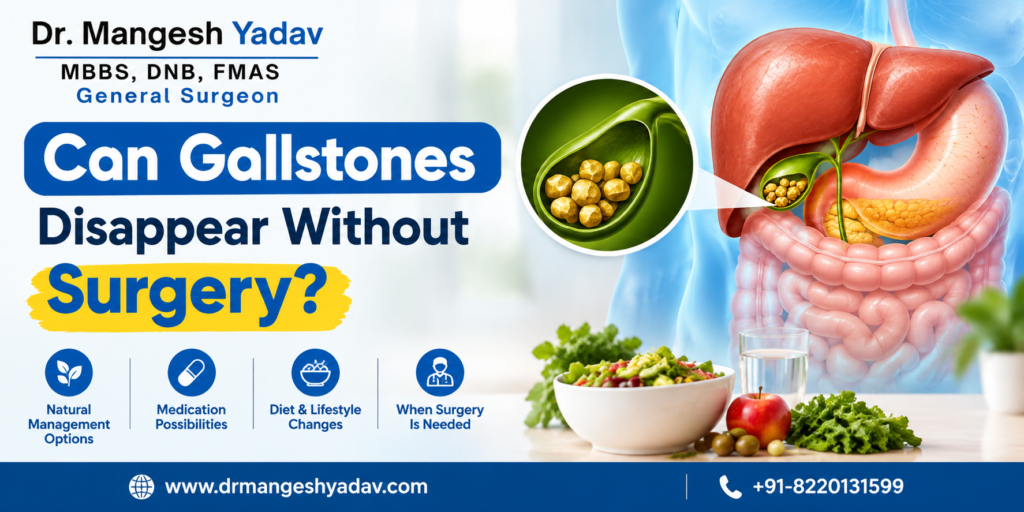
Non-Surgical Treatment for Gallbladder Stones: 6 Options
Here is how gallbladder treatment without surgery actually works, from the simplest option to the most specialised.
1. Watchful Waiting
If the stones were found by chance and you have no symptoms, treatment is not required. You simply know they are there and report any new pain. For many people, this is the whole plan.
2. Dissolving Medicines
This is the most common answer to “how to cure gallbladder stone without operation.” Doctors prescribe bile acids, usually ursodeoxycholic acid or chenodeoxycholic acid, to dissolve small stones and stop them growing.
The catch is the timeline and the odds:
- Treatment takes at least 6 to 12 months.
- It works only for small, non-calcified cholesterol stones in a healthy gallbladder.
- Stones can return within five years.
The dose and duration are set by your doctor. Do not start these medicines on your own.
3. Shock Wave Lithotripsy (ESWL)
Extracorporeal shock wave lithotripsy uses high-energy sound waves to break stones into smaller pieces. It needs no anaesthesia and can be done as an outpatient procedure.
It suits people with small stones and a normally functioning gallbladder. People who cannot have surgery may also qualify.
4. Percutaneous Therapy
Surgery can be risky for some high-risk patients. In that case, a doctor may work through the skin instead.
There are two versions:
- Cholecystoscopy: The doctor opens a tract into the gallbladder, widens it, and removes the stones with a scope.
- Contact dissolution therapy: A catheter is placed in the gallbladder and a solvent is injected to dissolve cholesterol stones.
5. Endoscopic Gallbladder Stenting
For high-risk patients who cannot undergo surgery, usually because of another illness, a doctor can perform an ERCP and place a stent from the gallbladder to the duodenum. The stent relieves symptoms and complications. It manages the problem rather than clearing every stone.
6. Percutaneous Cholangioscopy With Dual Modality Lithotripsy
This is the newest of the six options, and a real case shows how it works. In August 2023, MedStar Washington Hospital Center in the United States described a procedure for people who cannot, or do not want to, have surgery. Many of these patients were already living with a gallbladder drain (a percutaneous cholecystostomy tube) placed after an earlier infection.
Through that existing drain, doctors insert a small camera into the gallbladder without making a new incision. Stones smaller than 1.5 cm are removed with baskets and lasers. Larger stones are broken up by a probe that combines shock pulses and ultrasonic waves, and the particles are suctioned out.
The procedure takes under two hours, and most patients stay one night. In the team’s published research, the approach removed the stones completely, and all of their patients reported being pain-free and symptom-free afterwards. They are still tracking outcomes, so treat it as promising rather than settled. It is also a specialist service, not something every hospital offers.
Quick Comparison
Option | Best suited for | The catch |
Watchful waiting | No symptoms | Stones stay in place |
Dissolving medicines | Small, non-calcified cholesterol stones | 6 to 12 months; may recur within five years |
ESWL | Small stones, working gallbladder | Not for large or complicated cases |
Percutaneous therapy | High-risk patients | Needs a specialist team |
Endoscopic stenting | High-risk patients | Relieves symptoms, does not remove every stone |
Cholangioscopy + lithotripsy | Stones that surgery cannot address | Available only at selected centres |
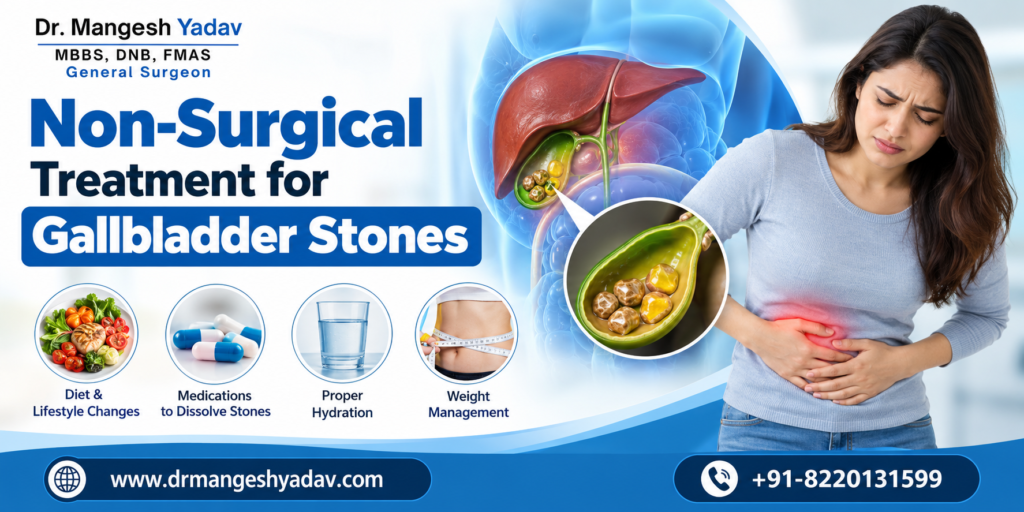
Can Gallstones Be Removed Without Removing the Gallbladder?
Yes, in two different ways, and people often confuse them.
Stones in the bile duct. A procedure called ERCP can remove stones from the bile duct. The gallbladder is not touched, so any stones inside it stay there unless another method deals with them.
Stones inside the gallbladder. Percutaneous cholangioscopy, described above, can remove these stones and leave the gallbladder in place. It is currently offered by specialist centres, and the team behind it says complete removal lowers the risk of recurring stones. Long-term results are still being collected.
If you want to remove gallstones without removing the gallbladder, the real question is whether your case fits one of these narrow routes.
Home Remedies and Gallbladder Cleanses: What the Evidence Says
Many people ask how to remove gallstones at home. The short version is that none of the popular methods has scientific proof behind it.
- Gallbladder cleanse or flush (olive oil, juice, herbs): no evidence it breaks up stones. It can be harmful for people with diabetes or low blood sugar.
- Apple juice: no studies show it softens or passes stones.
- Apple cider vinegar: no studies support it for gallstones.
- Milk thistle: not thoroughly studied for gallstones. Check with your doctor first, especially if you have diabetes.
- Artichoke: good for bile flow, but its effect on gallstones has not been studied. Never take it as a supplement without asking your doctor.
- Castor oil packs, acupuncture, gold coin grass, yoga: claims exist, but research is missing or limited.
A diet and herb that “might help prevent” stones is a very different claim from one that dissolves stones you already have. Tell your doctor before trying anything new.
Step-by-Step: How to Choose Gallstones Treatment Without Surgery
Use this order when you are weighing gallstone removal without surgery.
- Get the stones assessed. Ask for their size and type, and whether your gallbladder is working normally.
- Check your symptoms. Pain, fever, jaundice, dark urine or pale stools point towards a blockage or infection, which changes the plan.
- Match the stone to the option. Small, non-calcified cholesterol stones may suit medicines. Stones above 1.5 cm need a specialist procedure.
- Ask whether you are high-risk for surgery. Percutaneous treatment and stenting exist mainly for people who cannot safely have an operation.
- Ask about recurrence. With medicines, stones can return within five years. Get that number discussed before you commit to 6 to 12 months of treatment.
- Hold off on cleanses and supplements. Run every remedy past your doctor first.
When Surgery Is the Safer Choice
For stones that cause repeated attacks or blockage, surgery remains the standard route. Gallbladder surgery means removing the gallbladder itself, which is why recurrence is not a worry afterwards.
A recent case from Dr. Mangesh Yadav’s practice shows the kind of situation where medicines would not be the answer. On 20 April 2026, at Noble Hospital, he performed a robotic cholecystectomy for a patient with acute calculous cholecystitis and a stone impacted at the neck of the gallbladder. The patient was discharged on the second day after surgery. An inflamed gallbladder with an impacted stone is not the healthy gallbladder that dissolving medicines depend on.
If you want to see what a modern operation involves, read about robotic gallbladder surgery in Pune and what the week-by-week recovery looks like. Our overview of gallstones treatment covers the full range of options.
Conclusion
Gallstones can sometimes be treated without surgery, but they rarely disappear without help. Medicines work slowly and only for small, non-calcified cholesterol stones. Shock wave therapy, percutaneous treatment and stenting are mainly for people who cannot have an operation.
Cleanses, juices and supplements have no proven effect on stones. If your stones cause symptoms, the right choice depends on stone size, type, gallbladder health and your own risk, so get it assessed before you commit to any path.
Related Reading
Frequently Asked Questions
Can gallstones go away on their own without surgery?
Stones that cause no symptoms can simply be left alone and monitored. For symptomatic stones, small cholesterol stones may dissolve with bile-acid medicines such as ursodiol over 6 to 12 months or longer. Waiting without treatment is not a way to clear a stone that is causing pain.
Can gallstones be removed without removing the gallbladder?
Yes, in certain cases. ERCP removes stones from the bile duct while leaving the gallbladder alone. Percutaneous cholangioscopy can remove stones from inside the gallbladder and leave the organ in place, but it is offered only by specialist centres.
How to remove gallstones without surgery if they are small?
For small, non-calcified cholesterol stones in a gallbladder that works normally, doctors may prescribe ursodeoxycholic acid or chenodeoxycholic acid. Extracorporeal shock wave lithotripsy is another option for small stones. Your doctor decides which one fits after assessing the stones.
How long do gallstone dissolving medicines take to work?
Treatment usually takes at least 6 to 12 months. Even after the stones dissolve, there is a chance they will come back within five years. That is why many people still choose surgery for symptomatic stones.
How long does a gallbladder attack last?
They can. With medicines, recurrence within five years is a recognised risk. Specialist procedures that remove stones completely may lower that risk, but researchers are still tracking long-term outcomes.
Does a gallbladder cleanse or flush really remove gallstones?
There is no scientific evidence that it does. The body clears itself without a flush, and the mix of oil and juice can be harmful for people with diabetes or low blood sugar. Speak to your doctor before attempting any cleanse.
Do apple juice, apple cider vinegar or milk thistle dissolve gallstones?
No studies support these claims. Apple juice and apple cider vinegar have not been shown to soften or pass stones, and milk thistle has not been thoroughly studied for gallstones. Check with your doctor first, particularly if you have diabetes.
Do I need treatment if my gallstones don't hurt?
No. Gallstones that cause no symptoms generally need no treatment. See a doctor if you develop upper abdominal pain, nausea, fever, jaundice, dark urine or pale stools.