
Robotic Gallbladder Surgery in Pune: How the SSI Mantra 3.0 System Changes Recovery
- Home
- Hernia Care
- Robotic Gallbladder Surgery in Pune: How the SSI Mantra 3.0 System Changes Recovery
Robotic Gallbladder Surgery in Pune: How the SSI Mantra 3.0 System Changes Recovery

Written & Medically Reviewed By:
Dr. Mangesh Yadav
General, Laparoscopic & Robotic Surgeon
15+ Years of Surgical Experience
6,000+ Piles Cases Treated
Table of Contents
If you’ve been told you need your gallbladder removed, you’re probably dealing with a mix of relief and worry: relief that there’s a fix for the pain, and worry about surgery, recovery time, and getting back to work and family. That’s a normal reaction, and one I hear almost every week in my clinic.
Over the last few years, robotic gallbladder surgery in Pune has become a realistic option for many patients, thanks to indigenous platforms like the SSI Mantra 3.0 system. This article explains, in plain language, how robotic cholecystectomy works, how it’s different from standard laparoscopic gallbladder removal, and what you can genuinely expect during recovery without overselling the technology.
Overview
Robotic Gallbladder Surgery in Pune using the SSI Mantra 3.0 system is an advanced minimally invasive approach for removing the gallbladder. The robotic platform provides enhanced precision, 3D visualization, and controlled instrument movement, which may support smaller incisions, less postoperative discomfort, and a smoother recovery. Recovery time can vary depending on the patient’s health, surgical complexity, and the surgeon’s assessment.
Understanding Gallstones and When Surgery Is Needed
Gallstones form when bile hardens into stone-like deposits inside the gallbladder. Many people carry gallstones without symptoms for years. Surgery becomes necessary when stones cause:
- Recurring pain in the upper right abdomen, especially after fatty meals
- Nausea, vomiting, or bloating
- Jaundice (yellowing of skin or eyes)
- Inflammation of the gallbladder (cholecystitis) or blocked bile ducts
- Repeated episodes despite dietary changes
At this stage, gallstone treatment almost always means removing the gallbladder itself; medicines and diet changes rarely dissolve stones permanently, and the risk of complications rises with each episode.
Laparoscopic vs Robotic Gallbladder Removal: What's the Real Difference?
Both laparoscopic gallbladder removal and robotic cholecystectomy are minimally invasive; they use small incisions instead of one large cut. The difference lies in how the surgeon controls the instruments.
Laparoscopic Gallbladder Surgery
- Surgeon directly holds and moves straight, rigid instruments
- 2D camera view in most standard setups
- Well-established, safe, and effective for the vast majority of cases
- Shorter operating time in straightforward cases
Robotic Gallbladder Surgery
- Surgeon operates from a console, controlling robotic arms with wristed instruments that mimic natural hand movement
- 3D, high-definition, magnified view of the surgical field
- Greater precision around delicate structures like the bile ducts and blood vessels
- Reduced hand tremor, which can help in complex or inflamed gallbladders
In short: laparoscopic surgery remains an excellent, time-tested option for uncomplicated cases. Robotic surgery for gallstones adds an extra layer of precision and control, which can be particularly useful in patients with prior abdominal surgeries, significant inflammation, or anatomical variations.
What Is the SSI Mantra 3.0 System?
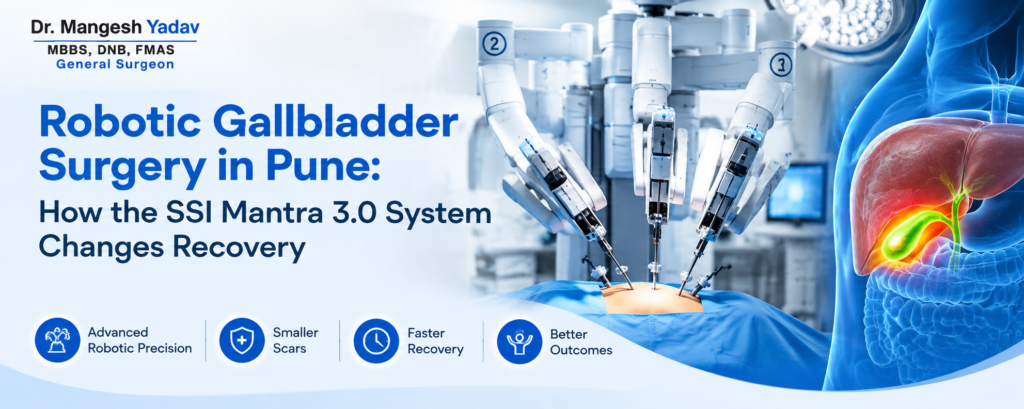
The SSI Mantra 3.0 is an Indian-developed surgical robotic platform used for a range of minimally invasive procedures, including robotic gallbladder removal. During surgery, the system allows the surgeon to sit at a console and guide robotic arms fitted with fine, wristed instruments through very small incisions in the abdomen.
Key features that matter for patients:
- Enhanced 3D visualization the surgeon sees the gallbladder, bile ducts, and surrounding blood vessels magnified in three dimensions
- Wristed instrument movement: instruments rotate and flex in ways the human wrist can’t, allowing more controlled dissection
- Tremor filtration: small, involuntary hand movements are filtered out, supporting steady, precise motion
- Small incision footprint: similar to laparoscopic surgery, using a few small ports rather than one large cut
It’s important to set realistic expectations: the robotic system is a tool that supports the surgeon’s skill and judgment; it does not operate independently, and outcomes still depend heavily on the surgeon’s experience and the patient’s individual condition.
How Robotic Gallbladder Surgery May Influence Recovery?
Every patient heals differently, and factors like age, inflammation severity, and overall health play a role. That said, several patterns are commonly seen with robotic cholecystectomy:
1. Smaller, More Precise Incisions
Because the robotic arms work through narrow ports with fine control, incisions are typically small and precisely placed, which can support a cleaner healing process.
2. Potentially Less Post-Operative Discomfort
The 3D magnified view and steady instrument control may reduce unnecessary tissue handling during dissection, which some patients report translates into less discomfort in the first few days.
3. Shorter Hospital Stay
Many patients undergoing robotic gallbladder removal for uncomplicated gallstone disease go home within 24 to 48 hours, similar to or sometimes shorter than laparoscopic timelines, depending on the individual case.
4. Faster Return to Light Activity
- Walk around the house: usually within a day
- Light daily activities: typically within 3–5 days
- Return to desk-based work: often within a week to 10 days
- Return to strenuous activity or heavy lifting: usually after 3–4 weeks, on your surgeon’s advice
5. Lower Risk of Wound-Related Complications
Smaller, precisely made incisions generally carry a lower risk of infection or hernia formation at the incision site compared to open surgery.
Gallbladder surgery recovery timelines should always be discussed individually with your surgeon, as pre-existing conditions, gallbladder inflammation, and prior surgeries can all affect healing.
Who Is a Good Candidate for Robotic Gallbladder Surgery?
Most patients diagnosed with symptomatic gallstones are candidates for either laparoscopic or robotic removal. Robotic surgery may be especially considered for:
- Patients with chronic gallbladder inflammation or thickened gallbladder walls
- Those with previous abdominal surgeries causing internal scar tissue (adhesions)
- Cases where precise dissection near the bile duct is anticipated
- Patients who prefer the enhanced precision robotic platforms offer
Your surgeon will evaluate your ultrasound reports, symptoms, and overall health before recommending the best surgical approach for you.
What to Expect: Before, During, and After Surgery
Before surgery:
- Blood tests, ultrasound, and a pre-anaesthesia check-up
- Fasting for 6–8 hours before the procedure
- Discussion of medical history and any current medications
During surgery:
- Performed under general anaesthesia
- Typically takes 45 minutes to just over an hour, depending on complexity
- A few small incisions are made for the robotic ports
After surgery:
- Most patients are encouraged to walk within hours of surgery
- Pain is generally managed with oral medication
- Follow-up visit is usually scheduled within a week to check the incision sites and discuss the pathology report
Conclusion
Robotic Gallbladder Surgery in Pune with systems like the SSI Mantra 3.0 offers a precise, minimally invasive option for treating symptomatic gallstones, particularly in cases involving inflammation or a more complex anatomy. It doesn’t replace the value of laparoscopic surgery, which remains a safe and reliable standard for many patients; rather, it adds another well-suited tool for the right clinical situation.
The most important factor in a good outcome isn’t the technology alone, but an accurate diagnosis and a surgeon experienced in both approaches who can guide you to the option best suited to your condition.
About Dr. Mangesh Yadav
With more than 15 years of surgical experience, Dr. Mangesh Yadav combines clinical expertise with advanced laparoscopic and Robotic technology to provide evidence-based and patient-focused treatment.
Related Reading
Frequently Asked Questions
Is robotic gallbladder surgery safe?
Yes. Robotic gallbladder surgery is considered a safe, well-established minimally invasive procedure when performed by a trained surgeon, with success rates comparable to laparoscopic surgery.
How long does gallbladder removal recovery take?
Most patients return to light daily activities within 3–5 days and resume normal work within a week to 10 days. Full gallbladder removal recovery time, including strenuous activity, is usually around 3–4 weeks.
Is robotic surgery better than laparoscopic gallbladder removal?
Not necessarily “better” for every case it offers added precision and 3D visualization, which can help in complex or inflamed gallbladders, while standard laparoscopic surgery remains excellent for straightforward cases.
How many incisions are needed for robotic cholecystectomy?
Typically 3–4 small incisions are used, similar in number and size to laparoscopic surgery.
Will I need to stay in the hospital for long?
Most patients undergoing robotic gallbladder removal are discharged within 24–48 hours, depending on their overall condition.
Does robotic gallstone surgery leave visible scars?
Incisions are small and typically heal into faint marks over a few months, similar to laparoscopic scars.
Can gallstones come back after gallbladder removal?
No, once the gallbladder is removed, gallstones cannot form again in that location, though rare bile duct stones can occur separately.
Who should consider robotic surgery for gallstones?
Patients with chronic inflammation, prior abdominal surgeries, or anatomically complex cases are often good candidates for robotic surgery for gallstones, though your surgeon will confirm suitability after evaluation.
Need Help? We’ve Got You Covered
Contact Details
Clinic Address
Vishwaraj Hospital, Pune Solapur Road, Loni Kalbhor, Pune 412201
Monday To Saturday: 03.00 PM to 05.00 PM / 07.00 PM to 08.30 PM
Sunday: 10.30 AM to 01.00 PM