
Gallstones Symptoms vs Kidney Stones | What’s the Difference?
- Home
- Hernia Care
- Gallstones Symptoms vs Kidney Stones | What’s the Difference?
Gallstones Symptoms vs Kidney Stones | What's the Difference?

Written & Medically Reviewed By:
Dr. Mangesh Yadav
General, Laparoscopic & Robotic Surgeon
15+ Years of Surgical Experience
6,000+ Piles Cases Treated
Table of Contents
Pain under your right ribs that starts after dinner and creeps toward your back sends a lot of people to Google with the same question: gallstones or kidney stones?
The two conditions share the word “stone” and little else. One sits in your digestive system, the other in your urinary tract, and the pattern of pain usually points to one or the other. This guide walks through gallstone symptoms in detail, compares them with kidney stone symptoms, and explains what treatment looks like for each.
Overview
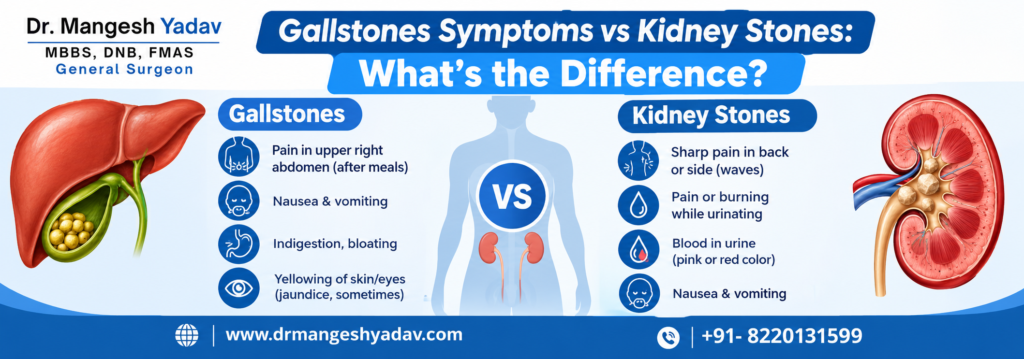
Gallstones and kidney stones can both cause severe pain, nausea, and vomiting, but they affect different parts of the body. Gallstones typically cause pain in the upper right or upper middle abdomen, often after fatty meals, while kidney stones commonly cause sharp pain in the side or back that may radiate toward the lower abdomen or groin. Urinary symptoms are more common with kidney stones, whereas gallstones may cause digestive symptoms such as bloating or indigestion. Proper diagnosis through medical evaluation and imaging can help determine the cause and guide appropriate treatment.
Gallstones vs Kidney Stones
Gallstones are hardened deposits of cholesterol or bilirubin that form in the gallbladder, a small pouch under the liver that stores bile. Kidney stones are mineral crystals, usually calcium-based, that form in the kidneys and travel down the ureter toward the bladder.
Because the organs sit in different places, the pain lands in different places too. Here is the side-by-side view:
Gallstones | Kidney stones | |
Organ involved | Gallbladder (under the liver) | Kidney or ureter |
Where it hurts | Upper right abdomen or centre of the upper abdomen | Flank (side and back, below the ribs), moving toward the groin |
Pain pattern | Builds, then stays steady for 30 minutes to several hours | Comes in waves that peak and ease |
Common trigger | Fatty or heavy meal, often in the evening | Low fluid intake, heat, long gaps without water |
How you behave | Tend to lie still or curl up | Cannot get comfortable, keep shifting or pacing |
Urine changes | None | Pink, red, or brown urine, burning, frequent urge |
Digestive signs | Bloating, belching, nausea after meals | Nausea and vomiting from the pain itself |
Who gets it more | Women, people over 40, after pregnancy or rapid weight loss | Men more often, people who drink little water |
First test | Abdominal ultrasound | Urine test plus ultrasound or CT scan |
Who treats it | General or laparoscopic surgeon, gastroenterologist | Urologist |
Treat the table as a starting point. Only imaging can be sure.
Gallstones Symptoms
Most gallstones cause no symptoms at all. They are often found by chance on an ultrasound done for another reason, and people in that group usually need no treatment.
Symptoms start when a stone blocks the gallbladder’s exit or lodges in a bile duct.
Gallbladder Stone Symptoms During an Attack
A gallbladder attack (doctors call it biliary colic) has a recognisable signature:
- Pain in the upper right abdomen, or in the centre just below the breastbone
- Pain that builds over 15 to 30 minutes, then stays steady for 30 minutes to several hours
- Pain that spreads to the right shoulder blade or between the shoulder blades
- Nausea, sometimes vomiting
- Onset after a fatty or large meal, often in the evening or at night
Fat is the trigger because it makes the gallbladder contract hard. If a stone is sitting at the exit, the squeeze has nowhere to go, and you feel it as pain.
Gallbladder Stone Symptoms Between Attacks
Some people never get a dramatic attack, just bloating, belching, a heavy feeling after meals, and a growing reluctance to eat fried food.
These are easy to blame on acidity, which is why gallstones are often treated with antacids for months before anyone orders an ultrasound.
Gallstones Symptoms in Females: Why They Get Missed and How They’re Treated
Women develop gallstones about twice as often as men. Oestrogen raises the cholesterol content of bile, while pregnancy, hormonal contraceptives and hormone therapy slow the gallbladder’s emptying. Rapid weight loss, including on some weight-loss medicines, adds to the risk.
In women, the pain is often described as “gas” or “acidity” and brushed aside. It can also feel like upper abdominal pressure with nausea, which overlaps with how heart attacks sometimes present in women. If chest tightness, sweating or breathlessness come with the pain, get emergency care first and think about the gallbladder later.
Gallstones symptoms in women: treatment follows the same logic as for men: no symptoms, no surgery; repeated attacks, remove the gallbladder. Pregnancy changes the timing. Doctors prefer to manage attacks with diet and monitoring where possible, and when surgery cannot wait it is generally done in the second trimester.
Red-Flag Gallstones Symptoms
A stone that stays stuck can inflame the gallbladder (cholecystitis), block the bile duct, or trigger pancreatitis. Get same-day care for:
- Pain lasting more than 5 to 6 hours
- Fever or chills with abdominal pain
- Yellow skin or eyes, dark urine, or pale stools
- Vomiting that will not stop
- Severe upper abdominal pain that bores through to the back
Kidney Stone Symptoms: How the Pain Differs
Kidney stone pain starts in the flank, the area between your ribs and hip, and travels toward the groin as the stone moves into the ureter. It arrives in waves, and most people cannot find a comfortable position. That restlessness is one of the clearest contrasts with a gallbladder attack.
Other signs include pink, red, or brown urine, a burning feeling when passing urine, a constant urge to go, and nausea. Fever with flank pain suggests infection behind a blocked kidney and needs emergency care.
Most kidney stones under about 5 mm pass on their own within a few weeks with plenty of fluids and pain relief. Larger stones need a urologist.
Step-by-Step: Is It Gallstones or Kidney Stones?
Use these five steps while the pain is fresh, and take your answers to the appointment.
- Locate the pain. Upper right abdomen or centre of the upper abdomen points to the gallbladder. A deep ache in the side or back, below the ribs, points to the kidney.
- Check the pattern. Steady pain that plateaus for an hour or more fits gallstones. Waves that rise and fall fit a kidney stone.
- Note what came before. A fatty meal in the last few hours favours gallstones. A hot day, a long gap without water, or a past kidney stone favours the kidney.
- Look at the extras. Bloating and nausea after meals suggest the gallbladder. Blood in the urine or burning while passing it suggests the urinary tract.
- Get the right scan. An abdominal ultrasound shows gallstones and their size. A urine test with an ultrasound or CT scan confirms a kidney stone. Do not treat yourself on guesswork.
Right-sided pain has other causes too. Appendicitis symptoms typically start near the navel and shift to the lower right abdomen, which is a different pattern from the upper-right pain of gallstones.
Passing Gallstones Symptoms: What to Expect
A gallstone leaves the gallbladder through a narrow tube called the cystic duct, enters the common bile duct, and empties into the small intestine. Small stones can make this trip.
Passing gallstones symptoms usually include sudden sharp pain in the upper right or central abdomen, nausea and vomiting. When the stone moves on, the pain eases, often within a few hours. Some people pass stones without noticing, and stones in the stool are rarely seen.
Passing a stone does not fix the cause. The gallbladder keeps making them, so another attack is common. A stone on its way through the duct can also inflame the pancreas, which is why severe pain with vomiting should never be waited out at home.
Online “gallbladder flushes” with olive oil and lemon juice have no evidence behind them. The greenish lumps people pass afterwards are soap-like clumps of oil, not gallstones, and the delay can let a real problem get worse.
Gallbladder Stone Size | Does It Matter?
Gallbladder stones range from a grain of sand to a golf ball, and there can be one or hundreds. Size matters, but not in the way most people expect.
- Small stones (a few millimetres) can slip out of the gallbladder and lodge in the bile duct, causing jaundice or pancreatitis. Small does not mean harmless.
- Large stones (above roughly 3 cm) rarely leave the gallbladder, but long-standing inflammation around them is linked to a higher risk of gallbladder cancer, so surgeons take them seriously even when they are silent.
In practice, symptoms drive the decision more than size. A 6 mm stone causing repeated attacks needs treatment. A 12 mm stone found by accident in someone with no symptoms usually does not, apart from unusual situations such as a calcified gallbladder wall.
Gallbladder Stone Treatment: Your Options
Watchful Waiting for Silent Stones
If a scan shows silent gallstones and you have no symptoms, the standard advice is to leave them alone and come back if symptoms start.
Medicines That Dissolve Cholesterol Stones
Ursodeoxycholic acid can dissolve small cholesterol stones, but it takes months to years and works only on some stones. Stones often return after the tablets are stopped. It is mostly used for people who cannot safely have surgery.
Laparoscopic Gallbladder Removal
For repeated attacks, the dependable gallbladder stone treatment is laparoscopic cholecystectomy: removing the gallbladder through a few small keyhole incisions with a camera and fine instruments. Most patients go home the same day or the next day and return to desk work in about a week. If cost is a concern, see this guide to gallbladder removal surgery cost in Pune.
You do not need a gallbladder to live normally. Bile flows directly from the liver into the intestine instead of being stored first. If the gallbladder is inflamed, early surgery within the first few days is usually safer than prolonged waiting.
Stones in the Bile Duct
If a stone has slipped into the bile duct, a procedure called ERCP uses an endoscope to remove it. The gallbladder is then usually removed to stop more stones from forming.
Three Real-Life Patterns From Surgical Clinics
These are composite cases, with details changed to protect privacy. Each reflects a pattern that repeats in clinic.
The “acidity” that was never acidity. A woman in her mid-40s spends eight months on antacids for pain that always arrives after dinner and lasts about two hours. She has started skipping dinner on weekends. An ultrasound shows several stones of 4 to 8 mm.
The pacing patient. A man in his 30s, working long shifts and drinking little water in summer, wakes at 3 a.m. with severe side pain. He cannot sit or lie still, and his urine is pink. This is classic kidney stone pain, and the gallbladder is not involved.
The stone has moved. A woman who lost weight quickly after pregnancy develops sudden upper abdominal pain, then notices her eyes turning yellow. A stone has entered the bile duct. She needs ERCP first and gallbladder removal after.
When to See a Doctor
Book an appointment with Dr. Mangesh Yadav if you have:
- Repeated upper abdominal pain after meals
- Bloating that antacids do not fix
- One-sided pain that keeps returning
🚨 Go to an emergency department straight away if you have:
- Pain lasting more than 5 to 6 hours
- Fever with abdominal pain
- Yellow eyes or skin
- Severe pain with persistent vomiting
Conclusion
Gallstone symptoms centre on steady upper-right or central abdominal pain after fatty meals, with nausea and bloating. Kidney stones cause wave-like flank pain that travels to the groin, usually with urine changes. Size alone does not decide gallbladder stone treatment; symptoms do, and laparoscopic removal is the dependable fix for repeated attacks. An ultrasound settles most doubts quickly.
If gallstones fit your pattern, Dr. Mangesh Yadav in Hadapsar, Pune can review your scan and explain whether you need treatment or can simply keep watching.
Related Reading
Frequently Asked Questions
What are the first signs of gallstones in a woman?
Early signs are often vague: bloating, belching, and an uncomfortable fullness after fatty meals, sometimes mistaken for acidity. The first clear sign is usually a steady ache in the upper right or central abdomen that lasts at least 30 minutes, often with nausea. Pregnancy, hormonal medicines, and rapid weight loss make these symptoms more likely.
How do I know if my pain is gallstones or kidney stones?
Check location and rhythm. Gallstone pain sits in the upper abdomen, stays steady for hours, and tends to follow a heavy meal. Kidney stone pain starts in the flank, comes in waves, moves toward the groin, and often comes with pink or red urine. An ultrasound confirms which one you have.
Which side is gallstone pain on?
Mostly the upper right side, under the ribs, or in the centre of the upper abdomen. It can spread to the right shoulder blade. Pain isolated to the left side is unlikely to be from the gallbladder and should be assessed for other causes.
Can gallstones cause back pain?
Yes. Gallstone pain often reaches the right shoulder blade or the area between the shoulder blades. Severe pain that goes straight through to the back, especially with vomiting, can mean the pancreas is inflamed and needs urgent care. Lower back or flank pain is more typical of a kidney stone.
How long does a gallbladder attack last?
A typical attack lasts from 30 minutes to a few hours, then fades. Pain that continues beyond 5 to 6 hours, or comes with fever, suggests the gallbladder is inflamed (cholecystitis) and needs same-day medical review.
What does passing a gallstone feel like?
Most people feel sudden, sharp pain in the upper right or central abdomen with nausea or vomiting. As the stone moves into the intestine, the pain eases. Some stones pass with no noticeable symptoms. Passing gallstones symptoms that include fever, yellow eyes or dark urine point to a blocked duct and need urgent care.
Can you pass a gallstone in your stool without knowing?
Yes, small stones can travel through the bile duct into the intestine and leave in the stool unnoticed. Most stones are too small or too few to spot. Passing one does not stop the gallbladder from forming more.
What size gallbladder stone needs surgery?
There is no cut-off size. Surgery is recommended when stones cause symptoms such as repeated attacks, inflammation or bile duct problems, whatever their size. Silent stones are usually watched, except in special cases such as very large stones or a calcified gallbladder wall.
Is a 1 cm gallstone considered large?
A 1 cm (10 mm) stone is medium-sized. It is too big to pass through the duct easily, so it tends to cause blockage and pain at the gallbladder exit. Stones above about 3 cm are the ones surgeons treat as high-risk.
Need Help? We’ve Got You Covered
Contact Details
Clinic Address
Vishwaraj Hospital, Pune Solapur Road, Loni Kalbhor, Pune 412201
Monday To Saturday: 03.00 PM to 05.00 PM / 07.00 PM to 08.30 PM
Sunday: 10.30 AM to 01.00 PM