
Recovery After Laparoscopic Gallbladder Surgery: Week-by-Week Guide
- Home
- Hernia Care
- Recovery After Laparoscopic Gallbladder Surgery: Week-by-Week Guide
Recovery After Laparoscopic Gallbladder Surgery: Week-by-Week Guide

Written & Medically Reviewed By:
Dr. Mangesh Yadav
General, Laparoscopic & Robotic Surgeon
15+ Years of Surgical Experience
6,000+ Piles Cases Treated
Table of Contents
Laparoscopic gallbladder surgery (also called laparoscopic cholecystectomy) is one of the most common and safest procedures performed for gallstones. Because it uses small keyhole incisions instead of a large open cut, most patients recover faster, feel less pain, and return to their normal routine sooner than they expect.
Still, faster recovery does not mean instant recovery. Your body needs time to heal internally, adjust to digestion without a gallbladder, and rebuild energy. This guide breaks down recovery week by week, so you know exactly what is normal, what to expect, and when you can safely resume work, driving, exercise, and your usual diet.
How Long Does Recovery Take After Laparoscopic Gallbladder Surgery?
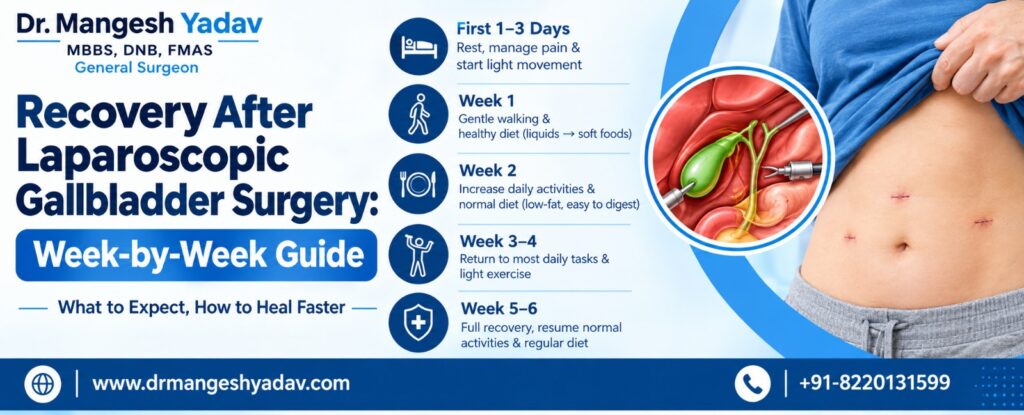
Most patients return to light daily activities within 3 to 5 days and feel largely back to normal within 1 to 2 weeks. Full internal healing, including settling of digestion, usually takes 4 to 6 weeks. Recovery speed depends on your age, fitness level before surgery, whether the surgery was straightforward or complicated, and how closely you follow post-operative advice.
Think of recovery less as a single deadline and more as a gradual climb: each week you should feel noticeably better than the one before.
First 24 Hours After Surgery
The first day sets the tone for the rest of your recovery, so it deserves extra attention.
Pain and discomfort: Some soreness around the incision sites and mild abdominal cramping is expected. Prescribed pain medication usually keeps this manageable.
Walking: You will likely be encouraged to get up and walk a short distance within a few hours of surgery. This helps reduce gas buildup and lowers the risk of blood clots.
Eating and drinking: Most patients start with clear liquids and progress to light, bland food as tolerated, based on your surgeon’s specific instructions.
Incision care: Keep the small bandages clean and dry as advised. Minor bruising around the cuts is common.
Rest: Plan to rest for most of the day. Fatigue after anesthesia is normal and should ease within 24 to 48 hours.
Days 2 to 7: What to Expect
Pain and bloating: Abdominal discomfort and bloating are common during this stretch. This happens because carbon dioxide gas, used to inflate the abdomen during surgery, is still being absorbed by the body.
Shoulder pain from surgical gas: Many patients are surprised by pain in the tip of the shoulder. This is referred pain from the leftover gas irritating the diaphragm, and it typically fades within a few days.
Fatigue: Low energy is completely normal. Your body is using resources to heal internally.
Light walking: Short, gentle walks several times a day help with digestion, circulation, and reducing gas pain.
Diet: Small, low-fat meals are easier to digest during this period. Large or fatty meals may cause discomfort or loose stools.
Sleeping: Some patients find it more comfortable to sleep propped up slightly with pillows for the first few nights.
Showering: Most surgeons allow a normal shower within 24 to 48 hours, while advising against soaking incisions in a bathtub or pool until they are fully healed.
Week 1: Settling Into Recovery
What is normal: Mild swelling, occasional pulling sensations near the incisions, tiredness by the afternoon, and bloating after meals.
Activities you can do:
- Light household movement such as walking around the house
- Sitting up for meals and short periods of reading or screen time
- Gentle stretching if it does not strain the abdomen
What to avoid:
- Lifting anything heavier than a few kilograms
- Driving, especially if still taking prescription pain medication
- Strenuous bending or twisting at the waist
Wound care: Keep incisions clean, watch for any unusual redness, and follow your surgeon’s instructions on when dressings can be removed.
Week 2: Regaining Momentum
By the second week, most patients notice a clear improvement in energy and comfort.
Energy improvement: Fatigue starts to lift, and short activities feel less draining.
Returning to work: People with desk jobs often return around this time, provided pain is controlled and energy has improved.
Driving: Many patients can resume driving once they are off narcotic pain medication and can comfortably perform an emergency stop without hesitation or pain.
Normal household activities: Light cooking, folding laundry, and short errands are usually fine, as long as they do not involve heavy lifting.
Diet progression: Most people can slowly reintroduce a wider variety of foods, watching for any that trigger bloating or loose stools.
Weeks 3 to 4: Building Back to Normal
Exercise: Light cardio such as walking briskly or gentle cycling is usually welcomed. Core-focused exercises are typically introduced more cautiously.
Normal diet: Most patients can eat a fairly regular diet by now, though very fatty or fried meals may still cause temporary discomfort for some.
Work and daily routine: People in physically moderate roles often return to work during this window, once cleared by their surgeon.
Lifting restrictions: Many surgeons ease lifting limits around this stage, though heavy lifting is still generally discouraged until full clearance.
Returning to physical activity: Gym sessions, swimming, and more structured workouts are often reintroduced gradually, starting light and building up.
Weeks 5 to 6 and Beyond
When most patients feel fully recovered: By six weeks, the majority of patients report feeling close to their pre-surgery normal, with incisions fully healed and energy restored.
Persistent digestive symptoms: A small number of patients experience ongoing loose stools or bloating after fatty meals for several weeks or longer, as the body adjusts to digesting fat without a gallbladder. This usually settles with time and dietary adjustment.
When follow-up may be needed: If digestive symptoms, pain, or wound concerns persist beyond six weeks, a follow-up visit is a good idea to rule out any complications.
What Can You Eat After Gallbladder Removal?
Diet plays a major role in how comfortable your recovery feels.
In the first days and weeks, favor:
- Low-fat proteins such as boiled eggs, dal, and lean meat
- Steamed vegetables and soft fruits
- Whole grains in moderate portions
- Small, frequent meals rather than large ones
Foods that may trigger diarrhea or bloating:
- Fried and greasy foods
- Heavy cream-based dishes
- Excess spice or very rich sauces
- Carbonated drinks in large amounts
Gradual return to normal diet: Most people can slowly widen their diet over 4 to 6 weeks, reintroducing foods one at a time and noting anything that causes discomfort.
When Can You Return to Work?
The right timeline depends heavily on what your job involves.
Desk job: Typically 1 to 2 weeks, once pain is controlled and concentration has returned.
Moderate physical work: Often 2 to 4 weeks, once lifting and movement feel comfortable.
Heavy or manual work: Usually 4 to 6 weeks, or until your surgeon confirms it is safe to lift and strain without risk to the healing incisions.
When Can You Drive After Gallbladder Surgery?
Most patients can drive again around 1 to 2 weeks after surgery, once they are no longer taking sedating pain medication, can twist and check mirrors comfortably, and can react quickly enough for an emergency stop without pain interfering.
When Can You Exercise After Gallbladder Removal?
Exercise after gallbladder surgery is not an all-or-nothing decision. Your abdominal muscles, incision sites, and internal tissue need time to heal in stages, so activity should build up gradually rather than jumping straight back into your old routine. Pushing too hard too soon can cause swelling, pulling at the incision sites, or a hernia at the surgical opening, while staying too inactive for too long can slow circulation and prolong stiffness. The goal is steady, comfortable progress, with your body (and your surgeon) guiding the pace.
Light walking can usually start on day one, since it is gentle enough not to strain the incisions while still helping move surgical gas out of the body and improving blood flow. More structured exercise then generally follows this pattern:
Week 1 to 2: Short walks only. This is the foundation phase. The focus is purely on short, slow walks indoors or in a quiet outdoor space, done a few times a day rather than one long session. Walking helps reduce the bloating and shoulder-tip discomfort caused by leftover surgical gas, keeps blood circulating to prevent clots, and gently wakes up the digestive system. Anything more demanding, such as stretching that engages the abdomen, lifting, or bending at the waist, should be avoided, since the incisions are still fresh and the internal tissue is in its earliest healing stage.
Week 2 to 3: Light cardio, gentle stretching As soreness eases and energy starts to return, walks can become brisker and slightly longer. This is also when very gentle stretching can be introduced, such as light shoulder rolls, neck stretches, or slow stretches that do not pull on the abdominal area. Light cardio at this stage means low-impact movement like a relaxed walk or an easy stationary cycle, kept at a pace where you can comfortably hold a conversation. The aim is to raise your heart rate mildly, not to build a sweat or work the core.
Week 3 to 4: Moderate cardio, light core work By this stage, most incisions are well into the healing process and internal tissue is stronger, so activity can step up moderately. Moderate cardio might include a faster walking pace, light cycling, or swimming (once the surgeon confirms the incisions are fully closed and safe for water exposure). Light core work can also begin cautiously, such as gentle seated twists or basic pelvic tilts, always stopping immediately if there is any pulling, sharp pain, or discomfort around the incision sites. This is not the stage for sit-ups, heavy planks, or intense ab workouts.
Week 5 to 6: Gradual return to regular gym routine and strength training This is typically when surgeons give the green light for a fuller return to normal exercise, including structured strength training, resistance exercises, and a regular gym routine. Even so, “gradual” is the key word: rather than jumping back into pre-surgery weights or intensity, ease into lighter loads and fewer sets first, then build back up over the following one to two weeks. Any twisting, heavy lifting, or high-impact activity such as running or intense HIIT sessions is usually best reserved for once your surgeon has specifically confirmed you are ready.
Throughout every stage, the same rule applies: if an activity causes pain, pulling at the incision, or noticeable swelling, stop and scale back. Everyone heals at a slightly different pace, so these timeframes are a general guide, and your surgeon’s individual clearance should always take priority over a generic schedule.
Day-by-day exercise progression
Day | Recommended Activity |
Day 1 | Short, slow walks around the room or hallway, a few times a day |
Day 2 to 3 | Slightly longer walks, several times daily, gentle movement only |
Day 4 to 7 | Outdoor walks of 10 to 15 minutes, light stretching if comfortable |
Day 8 to 14 (Week 2) | Brisker walks, gentle stretching, light household movement |
Day 15 to 21 (Week 3) | Light cardio such as steady walking or stationary bike, core-safe stretching |
Day 22 to 28 (Week 4) | Moderate cardio, light core-engaging movements introduced slowly |
Day 29 to 42 (Week 5 to 6) | Gradual return to regular gym routine and light strength training |
What Symptoms Are Normal After Surgery?
- Mild to moderate incision soreness
- Bloating and occasional gas pain
- Shoulder tip discomfort in the first few days
- Fatigue that improves week by week
- Occasional loose stools after fatty meals
- Slight bruising around incision sites
Warning Signs: When to Contact Your Doctor
Certain symptoms need prompt medical attention rather than waiting it out:
- Worsening abdominal pain instead of gradual improvement
- Fever or chills
- Persistent vomiting or inability to keep fluids down
- Redness, warmth, swelling, or discharge from an incision
- Yellowing of the skin or eyes (jaundice)
- Significant abdominal swelling or a hard, distended belly
If any of these appear, contact your surgical team promptly rather than waiting for your next scheduled visit.
Laparoscopic vs. Open Gallbladder Surgery Recovery
Recovery after laparoscopic surgery is generally shorter and less painful than after open gallbladder surgery. In some cases, a laparoscopic procedure may be converted to open surgery during the operation if needed for safety, which will naturally extend the recovery period. The table below compares the two side by side.
Factor | Laparoscopic Surgery | Open Surgery |
Incision size | Small keyhole cuts | Larger abdominal incision |
Hospital stay | Same day or 1 day | 2 to 4 days |
Initial pain level | Mild to moderate | Moderate to significant |
Return to light activity | Within 3 to 5 days | 1 to 2 weeks |
Return to desk work | 1 to 2 weeks | 3 to 4 weeks |
Full recovery | 4 to 6 weeks | 4 to 6 weeks or longer |
Scarring | Minimal, small marks | More visible incision line |
Conversion risk | May convert to open if needed | Not applicable |
Conclusion
Recovery after laparoscopic gallbladder surgery follows a fairly predictable path: a tender first few days, steady improvement through week one and two, a near-normal routine by week three or four, and full healing by six weeks. Everybody heals at a slightly different pace, so use this guide as a general roadmap rather than a strict rulebook, and always follow the specific instructions given by your surgical team.
If you are preparing for gallbladder surgery or navigating recovery and have questions specific to your situation, reach out to discuss your concerns and get personalized guidance for a smooth recovery.
Related Reading
- Want the detailed cost breakdown and a deeper look at why delaying treatment is risky? Read our full guide: Can a Hernia Heal on Its Own? The Dangerous Truth About Delaying Hernia Treatment in Pune
- Comparing your surgical options? See Laparoscopic vs Open Hernia Surgery: Cost & Recovery Timeline
- Curious what treatment actually costs? Check Hernia Surgery Cost in Pune
- Think it might be something else? Read about abdominal pain and lump evaluation
Frequently Asked Questions
How many days does it take to recover from laparoscopic gallbladder surgery?
Most people feel comfortable with daily activities within 1 to 2 weeks, while full internal healing takes closer to 4 to 6 weeks.
Can I walk after gallbladder surgery?
Yes, gentle walking is encouraged from the first day, as it helps reduce gas discomfort and supports healing.
When can I eat normal food?
Most patients gradually return to a regular diet within 2 to 4 weeks, starting with low-fat, easy-to-digest meals.
When can I sleep on my side?
Many patients find sleeping on their back or in a slightly elevated position more comfortable for the first week, and can usually return to their preferred sleeping position within 1 to 2 weeks as soreness fades.
When can I drive?
Typically 1 to 2 weeks after surgery, once off sedating pain medication and able to move comfortably.
When can I return to work?
Desk jobs often allow a return within 1 to 2 weeks, while physically demanding jobs may need 4 to 6 weeks.
When can I lift weights?
Light lifting is usually possible from week 3 to 4, with a full return to regular strength training around week 5 to 6, based on comfort and surgeon guidance.
Is diarrhea normal after gallbladder removal?
Yes, loose stools after fatty meals are common in the weeks following surgery as the body adjusts to digesting fat without a gallbladder. It usually improves with time and diet adjustment.
When should I worry about pain after surgery?
If pain worsens instead of gradually improving, or is accompanied by fever, vomiting, or wound changes, it is time to contact your doctor rather than waiting it out.
Can gallstones come back after gallbladder removal?
No, once the gallbladder is removed, gallstones cannot form again in that location, though rare stones can occasionally remain in the bile ducts and may need separate treatment.
Need Help? We’ve Got You Covered
Contact Details
Clinic Address
Vishwaraj Hospital, Pune Solapur Road, Loni Kalbhor, Pune 412201
Monday To Saturday: 03.00 PM to 05.00 PM / 07.00 PM to 08.30 PM
Sunday: 10.30 AM to 01.00 PM