
Pain While Passing Stool: Is It Fissure or Piles? Causes & Symptoms
- Home
- General & Laparoscopic Surgery
- Pain While Passing Stool: Is It Fissure or Piles? Causes & Symptoms
Pain While Passing Stool: Is It Fissure or Piles? Causes & Symptoms

Written & Medically Reviewed By:
Dr. Mangesh Yadav
General, Laparoscopic & Robotic Surgeon
15+ Years of Surgical Experience
6,000+ Piles Cases Treated
Table of Contents
Quick answer: If passing stool feels like a sharp, cutting or burning pain — almost like passing glass — and the pain lingers for minutes or even hours afterwards, it’s most likely an anal fissure (a small tear in the anal lining). If the main problem is painless bright red bleeding, itching, or a soft lump that comes out during motion, it’s more likely piles (swollen veins). Both are common, both are treatable, and both can exist together — so a quick examination is the only way to know for sure.
Few things make people dread the washroom like pain while passing stool. Many patients tell us they’ve started eating less or holding back the urge simply because they’re scared of the next visit. And almost everyone walks in saying the same thing: “Doctor, I think I have piles.”
Sometimes they’re right. But very often, especially when pain is the main complaint, the real culprit is a fissure. The two feel similar from the outside, yet they’re different problems with different treatments. Getting the diagnosis right is what decides whether you heal in two weeks or struggle for two years.
This article explains in simple words how to tell the difference, what causes each, and when it’s time to see a doctor.
Overview
This blog explains the difference between anal fissures and piles (hemorrhoids), focusing on why people experience pain while passing stool, how to identify the symptoms, their causes, treatment options, and when medical consultation is necessary.
It covers the key differences between fissures and piles, including sharp or burning pain, bleeding, itching, swelling, and lumps. The article also discusses other possible causes of anal pain, diagnostic procedures, non-surgical treatments, laser treatment options, home care tips, and preventive lifestyle changes.
The blog aims to help readers understand their symptoms, avoid self-diagnosis, and seek timely medical advice from Dr. Mangesh Yadav, General, Laparoscopic & Robotic Surgeon in Pune, for proper diagnosis and treatment.
What Does Pain While Passing Stool Usually Mean?
Pain during a bowel movement is your body’s way of saying something in the anal area is irritated, torn, swollen or infected. The two most common reasons are anal fissures and piles (hemorrhoids). Others include an anal abscess, a fistula, or less commonly inflammation of the rectum.
The type of pain, when it starts, how long it lasts, and what kind of bleeding you see give strong clues about which one you’re dealing with.
What Is an Anal Fissure?
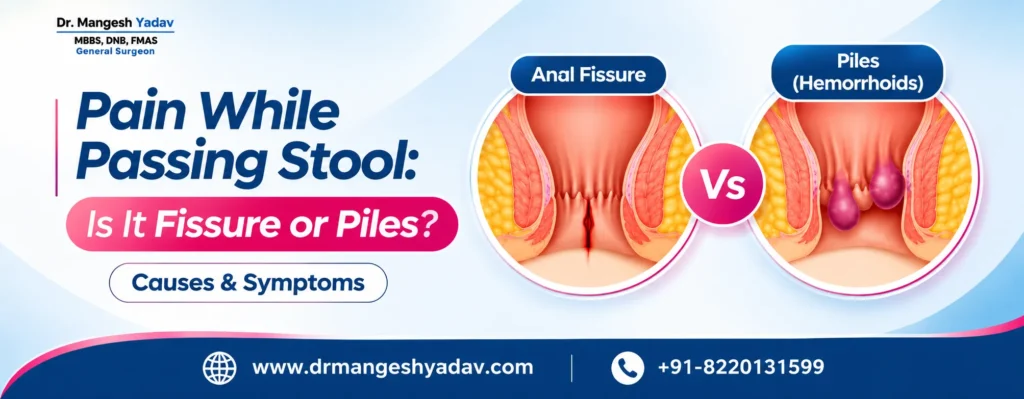
An anal fissure is a small tear or crack in the thin, delicate skin that lines the anus. Think of it like a paper cut at the corner of your mouth tiny, but painful every time it stretches.
Most fissures happen when a hard, dry or large stool stretches the anal opening beyond its limit. The tear then triggers a spasm of the inner anal muscle (the internal sphincter). That spasm squeezes the area tight, cuts down blood flow, and makes healing slow — which is why some fissures keep coming back.
- Acute fissure: recent (less than about 6 weeks), usually heals with diet and medicines.
- Chronic fissure: lasts longer than 6–8 weeks, often with a small skin tag at the edge (called a sentinel pile), and may need a procedure to heal.
What Are Piles?
Piles, or hemorrhoids, are swollen blood vessels in and around the anus and lower rectum. Everyone has these vascular cushions; they become “piles” when constant pressure from straining, constipation or long sitting makes them stretch, swell and bulge.
- Internal piles sit inside the rectum. They’re usually painless, but they can bleed or slip out during motion.
- External piles form under the skin around the anus. They can itch, ache, and become very painful if a blood clot forms inside them (a thrombosed pile).
Fissure vs Piles Comparison
Feature | Anal Fissure | Piles (Hemorrhoids) |
What it is | A tear in the anal lining | Swollen veins/cushions in or around the anus |
Type of pain | Sharp, cutting, burning — “like passing glass” | Usually mild ache or heaviness; often painless (internal) |
When pain happens | During motion and for minutes to hours after | Mostly during motion or after long sitting |
Bleeding | Small streak of bright red blood on stool or toilet paper | Bright red blood, can drip or splash into the pan |
Lump | Small skin tag in chronic fissure | Soft, swollen lump that may come out and go back in |
Itching | Sometimes | Common, especially external piles |
Fear of the toilet | Very common — people avoid going | Less common |
Feeling on touch | Hard to feel; very tender | Often a soft, squishy swelling |
Causes: Why Fissures and Piles Happen
Fissures and piles share many of the same triggers, which is why people often mix them up.
Common Causes
- Constipation and hard stools — the single biggest trigger
- Straining on the toilet
- Low-fibre diet — maida, fried snacks, fast food, too little dal, fruit and vegetables
- Not drinking enough water
- Long hours of sitting at a desk, in a car, or on the toilet with a phone
- Holding back the urge to pass stool
- Pregnancy and childbirth
- Obesity
More typical of fissures
- Passing a single very hard or large stool
- Frequent loose motions or chronic diarrhoea, which irritate the lining
- High resting tone of the anal sphincter muscle
- Less commonly, Crohn’s disease, infections or anal trauma
More typical of piles
- Chronic straining over months or years
- Heavy lifting with breath-holding
- Family history of piles
- Ageing, which weakens the supporting tissue
If long workdays at a desk are part of your routine, our article on how sitting jobs are increasing piles cases in India explains the link in detail.
Symptoms of an Anal Fissure
- Sharp, tearing or burning pain during a bowel movement
- Pain that lingers for several minutes to a few hours afterwards
- A small amount of bright red blood on the stool or toilet paper
- A visible crack or cut in the skin around the anus
- A small skin tag near the tear (in long-standing fissures)
- Itching or irritation
- Fear of passing stool, which leads to holding it in — making the next stool harder and the pain worse
Symptoms of Piles
- Painless, bright red bleeding — on paper, on the stool, or dripping into the pan
- A soft lump at the anus that may come out during motion and go back on its own or need to be pushed back
- Itching and irritation around the anus
- Mucus discharge or dampness
- A feeling of heaviness or that the bowel hasn’t fully emptied
- Discomfort while sitting for long
- Sudden severe pain with a hard, bluish lump — a sign of a thrombosed external pile
To understand how serious piles bleeding is, read bleeding piles: when should you see a piles doctor in Pune
Can You Have Both Piles & Anal Fissure at the Same Time?
Yes. It’s more common than most people think. Long-standing constipation and straining can cause piles and a fissure together. A chronic fissure can also leave behind a skin tag that looks like a pile, which is why patients are often told they have “piles” when the real problem is the tear underneath.
This matters because treating only the piles while ignoring a fissure — or vice versa — means the pain keeps coming back. A good examination looks for both. Our article on piles vs fissure: life after surgery, diet & habit changes explains how recovery differs for each.
Other Causes of Pain While Passing Stool
Not every painful motion is a fissure or piles. Other possibilities include:
- Anal abscess — a painful, swollen, pus-filled lump near the anus, often with fever
- Anal fistula — a small tunnel from the anal canal to the skin that leaks pus or blood; it usually follows an abscess. See our guide on the best treatment for anal fistula.
- Proctitis — inflammation of the rectum, sometimes linked to infections or inflammatory bowel disease
- Skin infections or irritation around the anus
- Rarely, growths or cancer of the anus or rectum — which is why persistent symptoms should always be checked, especially after age 40
How Doctors Confirm the Diagnosis
The thought of an examination worries many people, but it’s usually quick, private and done with great care.
- Conversation about your symptoms, bowel habits, diet and how long the problem has lasted
- Gentle visual examination — most fissures can be seen simply by parting the skin at the anal opening
- Digital rectal examination or proctoscopy to check for internal piles (often avoided or done very gently if a painful fissure is present)
- Colonoscopy or other tests only when needed — for example, with dark blood, weight loss, change in bowel habits, or age-related screening
In most cases, the diagnosis is clear in the very first visit.
Treatment Options for Piles & Anal Fissure
For anal fissure
- High-fibre diet, plenty of water and stool softeners to keep motions soft
- Warm sitz baths for 10–15 minutes, two to three times a day, to relax the muscle spasm
- Prescription ointments that relax the sphincter and improve blood flow so the tear can heal
- Laser fissure treatment or lateral internal sphincterotomy for chronic fissures that don’t heal with medicines — usually a day-care procedure with quick relief
Learn more about laser anal fissure treatment in Pune — procedure, cost & recovery, and see the anal fissure treatment cost in Pune.
For piles
- Diet, water, sitz baths and medicines for early (Grade I–II) piles
- In-clinic procedures like rubber band ligation for selected internal piles
- Laser piles treatment for larger, prolapsing or recurring piles — minimal bleeding, no open wound, and most people return to work within days
Read can piles be treated without surgery? and laser piles treatment in Pune — cost, benefits & procedure.
Simple Ways to Make Passing Stool Less Painful
While you wait for your consultation, these steps can ease pain and help healing:
- Eat more fibre — whole wheat roti, jowar or bajra bhakri, dal, rajma, papaya, guava, pear and green vegetables
- Take isabgol (psyllium husk) with a glass of water at night, if your doctor approves
- Drink 8–10 glasses of water through the day
- Go when you feel the urge — holding it makes stools harder
- Don’t strain, and keep toilet time to 3–5 minutes (leave the phone outside)
- Use a small footstool on a Western toilet to mimic a squatting position
- Take warm sitz baths after motion to relax the muscles and soothe pain
- Clean gently with water instead of rubbing with dry tissue
- Cut back on very spicy food, alcohol and excess tea or coffee
- Stay active — even a 30-minute daily walk helps the bowel move better
When to See a Doctor
Please don’t wait months hoping it will settle. Consult with a doctor if you notice:
- Pain while passing stool lasting more than 1–2 weeks
- Bleeding that is heavy, recurring, dark, or mixed with stool
- A hard, painful lump near the anus
- Fever, swelling or pus near the anus
- A change in bowel habits lasting more than 2–3 weeks
- Unexplained weight loss, tiredness, or a family history of colon cancer
- Symptoms that keep coming back despite treatment
Why Patients Trust Dr. Mangesh Yadav
Dr. Mangesh Yadav is a General, Laparoscopic & Robotic Surgeon in Pune with over 15 years of surgical experience and a focused practice in fissures, piles and fistulas. He treats patients from Hadapsar, Magarpatta, Kharadi, Loni Kalbhor and across Pune.
Every consultation begins with an honest, gentle examination to find out exactly what’s causing your pain fissure, piles, or something else. Treatment always starts with the simplest option that will work; procedures like laser treatment are recommended only when they genuinely offer faster, longer-lasting relief.
Book a Consultation — clinic hours: Monday to Saturday, 4:00 PM to 8:00 PM.
Frequently Asked Questions
How do I know if pain while passing stool is from a fissure or piles?
Fissure pain is sharp, cutting or burning, like passing glass, and often lasts minutes to hours after motion, with a small streak of bright red blood. Piles are usually painless and cause bright red bleeding, itching, or a soft lump that comes out during motion. A doctor’s examination confirms which one you have.
Is a fissure more painful than piles?
Yes, in most cases. An anal fissure is a tear in a very sensitive area, so it causes sharp pain during and after bowel movements. Internal piles are often painless, though external piles can become very painful if a clot forms.
What causes pain while passing stool?
The most common causes are anal fissures and piles, usually triggered by constipation, hard stools, straining, a low-fibre diet, low water intake and long sitting. Other causes include anal abscess, fistula and inflammation of the rectum.
Can a fissure turn into piles?
? A fissure does not turn into piles, but a chronic fissure can form a small skin tag called a sentinel pile, which looks like piles. Fissures and piles can also exist together because they share the same causes, such as constipation and straining.
Does a fissure heal on its own?
Many acute fissures heal within 4–6 weeks with a high-fibre diet, water, stool softeners, sitz baths and prescribed ointments. Fissures lasting beyond 6–8 weeks are considered chronic and may need laser treatment or a minor procedure to heal.
Is bleeding while passing stool always piles?
No. Bright red bleeding can come from piles or a fissure. Dark blood, blood mixed with stool, or bleeding with weight loss or changed bowel habits needs prompt medical evaluation to rule out other conditions
Which doctor should I see for pain while passing stool?
You should see a general surgeon or proctologist who treats anorectal conditions such as fissures, piles and fistulas. They can examine the area, confirm the cause and recommend the right treatment.
What can I do at home to reduce pain while passing stool?
Eat a high-fibre diet, drink 8–10 glasses of water a day, take a warm sitz bath after motion, avoid straining, don’t hold back the urge, and limit spicy food. If pain lasts beyond 1–2 weeks, see a doctor.
Need Help? We’ve Got You Covered
Contact Details
Clinic Address
Vishwaraj Hospital, Pune Solapur Road, Loni Kalbhor, Pune 412201
Monday To Saturday: 03.00 PM to 05.00 PM / 07.00 PM to 08.30 PM
Sunday: 10.30 AM to 01.00 PM