
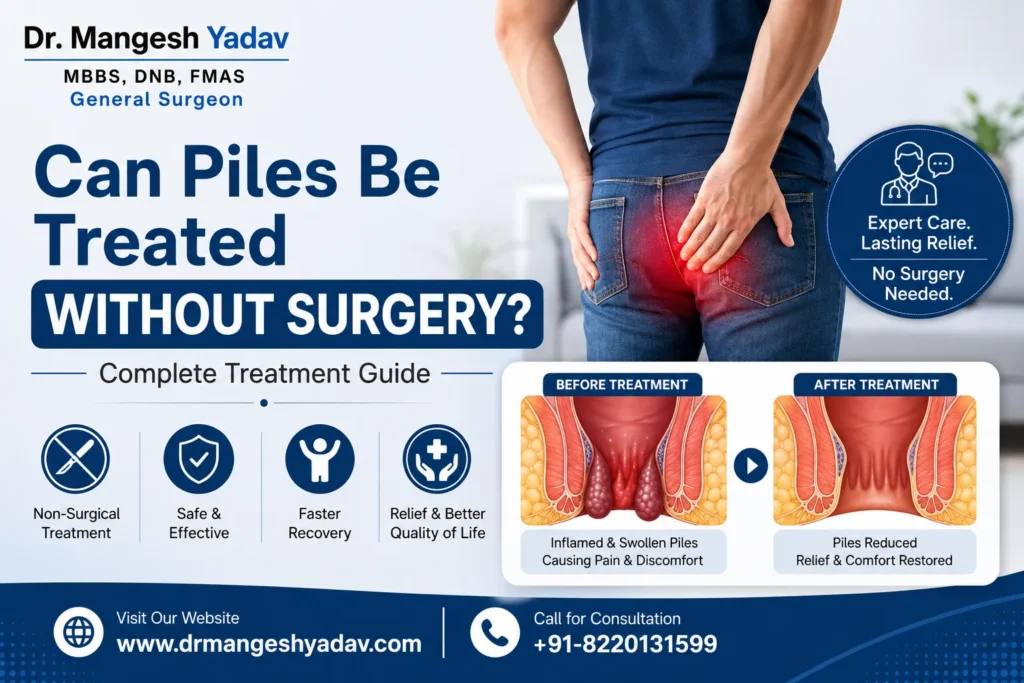
Can Piles Be Treated Without Surgery? Complete Treatment Guide
Written & Medically Reviewed By:
Dr. Mangesh Yadav
General, Laparoscopic & Robotic Surgeon
15+ Years of Surgical Experience
6,000+ Piles Cases Treated
Table of Contents
If you’ve been diagnosed with piles (hemorrhoids), the first question on most people’s minds isn’t “what caused this” — it’s “will I need surgery?” The short answer: no, not always. Most piles, especially Grade I and Grade II, respond well to non-surgical treatment — dietary changes, medication, and minor procedures done without a single cut. Surgery is usually reserved for advanced Grade III–IV piles or cases that don’t respond to conservative care.
This guide walks through exactly which non-surgical treatments work, how doctors decide, and when it’s time to consider a procedure like laser surgery.
AI;DR
Can Piles Be Treated Without Surgery? Complete Treatment Guide
Yes, many cases of piles can be treated without surgery, especially in the early stages. A high-fiber diet, plenty of water, regular exercise, avoiding straining, warm sitz baths, and doctor-recommended medicines can help relieve symptoms. For persistent piles, minimally invasive treatments like rubber band ligation may be considered. Surgery is usually recommended only for severe, recurrent, or advanced cases. Always consult a qualified doctor for the right treatment based on your condition.
What Are Piles (Hemorrhoids)?
Piles, medically known as hemorrhoids, are swollen, inflamed veins or vascular cushions in and around the anus and lower rectum. They form when increased pressure — from straining, chronic constipation, prolonged sitting, pregnancy, or heavy lifting — causes these veins to bulge.
There are two main types:
- Internal piles — form inside the rectum, usually painless but can cause bleeding and prolapse (protrusion).
- External piles — develop under the skin around the anus, and are more likely to cause pain, itching, and swelling, especially if a blood clot forms (thrombosed piles).
Common symptoms include bright red blood after passing stool, itching or irritation around the anus, a lump near the anal opening, discomfort while sitting, and a feeling of incomplete evacuation.
The 4 Grades of Piles and What Each One Needs
Doctors grade internal hemorrhoids on a scale of I to IV based on how much they prolapse (protrude). This grading is the single biggest factor in deciding whether surgery is needed.
| Grade | What It Looks Like | Typical Treatment |
|---|---|---|
| Grade I | Small, stay inside the anal canal, don’t prolapse | Diet, lifestyle changes, topical medication — almost always non-surgical |
| Grade II | Prolapse (come out) during straining but go back in on their own | Conservative care first; rubber band ligation, sclerotherapy, or infrared coagulation if needed — non-surgical |
| Grade III | Prolapse during straining and must be pushed back in manually | Often starts non-surgical/minimally invasive; surgery (including laser) if these fail or piles are large |
| Grade IV | Permanently prolapsed, cannot be pushed back in | Usually requires surgical treatment |
Can Piles Really Be Treated Without Surgery?
Yes — for the majority of patients, especially those with Grade I and Grade II piles, non-surgical treatment is the first and often only line of management. Even many Grade III cases are managed successfully with office-based, minimally invasive procedures before surgery is ever considered.
Surgery becomes necessary mainly when piles are large, permanently prolapsed (Grade IV), thrombosed, bleeding heavily, or simply haven’t improved despite proper conservative and minimally invasive treatment. The goal of any good proctologist is to use the least invasive option that will actually work not to jump straight to the operating table.
Non-Surgical Treatment Options for Piles
1. Dietary and Lifestyle Changes
This is where every treatment plan starts, regardless of grade.
- Increase fiber intake — whole grains, fruits, vegetables, and legumes soften stool and reduce straining.
- Drink enough water — at least 8–10 glasses a day to prevent hard stools.
- Avoid straining and prolonged toilet sitting — don’t hold your phone on the toilet; get up once the urge passes.
- Stay physically active — regular movement improves bowel regularity and reduces pelvic pressure.
- Manage weight — excess weight increases pressure on rectal veins.
Mild, Grade I piles frequently resolve within a week or two of these changes alone.
2. Oral Medication
Doctors may prescribe oral flavonoid-based medication (venotonics) to improve vein tone and reduce bleeding and swelling, along with stool softeners or mild laxatives to ease bowel movements. Pain relievers like paracetamol can help with discomfort.
3. Sitz Baths
Soaking the anal area in warm water for 10–15 minutes, two to three times a day, is one of the most effective and inexpensive home measures for reducing swelling and discomfort, particularly for external piles.
4. Stool Softeners and Bowel Training
Psyllium husk (isabgol) and other fiber supplements are commonly recommended in India to bulk up stool and reduce straining without medication side effects.
Minimally Invasive Procedures for Piles
Laser Piles Surgery (Laser Hemorrhoidoplasty)
For Grade II–IV piles, recurrent piles, or cases where banding and sclerotherapy haven’t held, laser piles surgery is the option Dr. Mangesh Yadav most often recommends over traditional open hemorrhoidectomy. It is technically a surgical procedure, but a minimally invasive one:
- How it works: A precision laser fiber is inserted into the hemorrhoidal tissue to seal off the blood vessels feeding it. The pile shrinks and gradually fibroses, without cutting or removing external skin or tissue.
- No stitches, minimal bleeding: Unlike conventional hemorrhoidectomy, laser treatment doesn’t involve open wounds, so there’s little to no bleeding and nothing to suture.
- Day-care procedure: Done under local or spinal anesthesia in about 20–30 minutes, with most patients discharged the same day — no multi-day hospital stay.
- Faster recovery: Most patients are back to normal activity within 2–4 days, compared to 2–4 weeks after open surgery, with significantly less post-operative pain.
- Lower recurrence and complication risk: Laser’s precision reduces damage to surrounding sphincter muscle, lowering the risk of complications like anal stenosis seen with some traditional techniques.
- Effective across grades: Unlike RBL or sclerotherapy, laser treatment works well even for larger, prolapsed Grade III–IV piles.
You can read the full step-by-step procedure in our detailed guide, laser surgery for piles: procedure, benefits and recovery.
Rubber Band Ligation (RBL)
A tiny rubber band is placed around the base of an internal hemorrhoid to cut off its blood supply. The pile shrinks and falls off within about a week.
Sclerotherapy
A chemical solution is injected into the hemorrhoid to shrink it. It works well for smaller piles but is less effective on larger ones.
Non-Surgical vs Laser vs Traditional Surgery
| Factor | Non-Surgical Treatment | Laser Surgery | Traditional Hemorrhoidectomy |
|---|---|---|---|
| Best for | Grade I–II, early Grade III | Grade III–IV, recurrent or large piles | Very large, complex, or multiple piles |
| Anesthesia | None or local | Local/spinal | General/spinal |
| Hospital stay | None (OPD) | Same-day / day-care | 1–3 days |
| Pain & recovery | Minimal, quick | Mild, 3–7 days | Higher, 2–4 weeks |
| Downtime | Little to none | 2–4 days | 1–3 weeks |
If cost is a factor in your decision, our guide on piles surgery cost in Pune breaks down pricing across laser, stapler, and open surgery.
How to Prevent Piles From Coming Back
ven after successful non-surgical treatment, piles can recur without lasting lifestyle changes:
- Keep a high-fiber diet as a permanent habit, not a temporary fix
- Stay hydrated throughout the day
- Avoid straining — never rush or force a bowel movement
- Exercise regularly to support healthy digestion
- Don’t delay the urge to pass stool
- Limit time spent sitting on the toilet (avoid reading or scrolling there)
Understanding your personal risk factors also helps our article on causes of piles in men covers lifestyle and occupational triggers worth knowing.
When to See a Doctor
Don’t self-diagnose rectal bleeding as “just piles.” See a doctor promptly if you experience:
- Bleeding that is heavy, dark, or accompanied by weakness
- A change in bowel habits lasting more than a few weeks
- Severe pain, especially with a hard lump (possible thrombosis)
- Piles that don’t improve after a week of home care
- Unexplained weight loss alongside rectal symptoms
A proper examination is the only way to confirm it’s piles and not another condition affecting the anorectal region, such as a fissure, fistula, or — rarely — something more serious that needs to be ruled out.
Why Patients in Pune Trust Dr. Mangesh Yadav for Piles Treatment
What Is Recovery After Piles Treatment?
Recovery depends on the treatment you receive.
After minimally invasive procedures, patients may be able to return to light activities relatively quickly. However, bowel movements may remain uncomfortable for a short period.
Your doctor may recommend:
- Adequate fluids
- Fibre-rich foods
- Constipation prevention
- Regular light walking
- Avoiding unnecessary straining
- Following prescribed medicines
- Avoiding heavy lifting until advised
Keeping stools soft is particularly important because straining can aggravate hemorrhoidal symptoms.
Why Choose Dr. Mangesh Yadav for Bleeding Piles Treatment in Pune?
Dr. Mangesh Yadav is a General, Laparoscopic and Robotic Surgeon practicing in Hadapsar, Pune. His official profile highlights 15+ years of surgical experience and 6,000+ piles treatments.
Depending on the diagnosis and severity, treatment may involve conservative management, medication, minimally invasive procedures, or surgery.
For patients looking for an experienced Piles Doctor in Pune, Piles Specialist in Hadapsar, or General Surgeon in Hadapsar, Dr. Mangesh Yadav offers specialized care for piles and other anorectal conditions. Every treatment plan starts with an honest assessment of whether non-surgical care will work for you — surgery is only recommended when it’s genuinely the better option, not the default one.
Frequently Asked Questions
Can piles be cured completely without surgery?
Yes, Grade I and Grade II piles can often be fully resolved without surgery through dietary changes, medication, and minor procedures like rubber band ligation. Grade III and IV piles are less likely to resolve completely without a surgical or laser procedure.
What is the most effective non-surgical treatment for piles?
ubber band ligation is considered the most effective non-surgical, in-clinic procedure for internal piles that don’t respond to diet and medication alone, with success rates significantly higher than sclerotherapy for larger hemorrhoids.
How long does it take for piles to heal without surgery?
Mild (Grade I) piles often improve within 7–10 days with dietary changes and topical treatment. Piles needing a procedure like banding typically resolve within 1–2 weeks of the treatment.
Can Grade 3 piles be treated without surgery?
Sometimes. Early or smaller Grade III piles may respond to rubber band ligation or sclerotherapy, but larger or recurrent Grade III piles usually need laser or surgical treatment for lasting relief.
What foods should be avoided with piles?
Low-fiber, processed foods, excess spicy food, red meat in large amounts, and alcohol can worsen constipation and straining, making piles worse.
Can piles come back after non-surgical treatment?
Yes, piles can recur if the underlying causes — low fiber intake, straining, prolonged sitting, or constipation — aren’t addressed long-term, even after successful treatment.
Is laser treatment for piles considered surgery?
Yes, technically laser hemorrhoidectomy is a surgical procedure, but it’s minimally invasive compared to traditional open surgery, with less pain, less bleeding, and a much faster recovery — often done as day care with no overnight stay.
Need Help? We’ve Got You Covered
Contact Details
Clinic Address
Vishwaraj Hospital, Pune Solapur Road, Loni Kalbhor, Pune 412201
Monday To Saturday: 03.00 PM to 05.00 PM / 07.00 PM to 08.30 PM
Sunday: 10.30 AM to 01.00 PM