
How Sitting Jobs Are Increasing Piles Cases in India | Causes & Prevention
Written & Medically Reviewed By:
Dr. Mangesh Yadav
General, Laparoscopic & Robotic Surgeon
15+ Years of Surgical Experience
6,000+ Piles Cases Treated
Table of Contents
Ten years ago, a typical piles patient walking into a surgeon’s clinic was in his fifties. Today, it’s just as likely to be a 28-year-old software engineer from Kharadi or Magarpatta or a young CA who has been working ten-hour days through tax season.
The pattern is hard to miss. India’s working life has moved from fields and factory floors to chairs, car seats and sofas and our bodies, especially the lower back and the rectal area, are paying the price.
In this article, we’ll look at why sitting jobs are pushing piles cases up, who is most at risk, the early signs to watch for, and practical prevention steps you can start at your desk today.
Quick answer: Sitting for long hours doesn’t directly “create” piles, but it raises the risk significantly. Constant sitting pushes pressure onto the veins around the anus, slows blood flow, and makes constipation more likely — and together, these swell the veins into piles. Research suggests that people who sit for 5 or more hours a day have a noticeably higher risk of piles and fissures. The good news: simple habits like hourly movement breaks, a fibre-rich diet, enough water, and short toilet visits can prevent most cases.
Overview
This blog explains how prolonged sitting and sedentary work habits are contributing to an increased risk of piles (hemorrhoids) among working professionals in India. It highlights how long desk hours, poor circulation, constipation, low-fibre diets and excessive toilet sitting can increase pressure on anal veins. The article discusses common risk groups, including IT professionals, work-from-home employees, drivers, accountants and students. It also explains the early warning signs of piles, anal fissures and fistulas that people should not ignore. Readers will discover practical prevention tips, including regular movement breaks, a fibre-rich diet, proper hydration and healthy toilet habits. The blog also covers available treatment options, including medicines, minimally invasive procedures and laser surgery. Finally, it highlights Dr. Mangesh Yadav’s surgical expertise and the importance of timely medical consultation for proper diagnosis and treatment.
India's Sitting Problem in Numbers
A large study published in The Lancet Global Health in 2024 found that nearly half of Indian adults (49.4%) didn’t get enough physical activity in 2022 up from about 22% in 2000. Women were even more affected than men. And if the trend continues, the researchers projected that the number could reach close to 60% by 2030.
Put that next to how most of us work now:
- 8–10 hours at a desk, often without a proper break
- 1–2 hours of commuting, sitting in a car, cab, bus or on a two-wheeler
- 2–3 hours of evening screen time on the sofa
- Plus the 10–15 minutes on the toilet scrolling Instagram
That easily adds up to 12+ hours of sitting a day. A case–control study on prolonged sitting found that people who sat for 5 hours or more daily had roughly 3.7 times higher odds of developing hemorrhoids and/or anal fissures than those who sat less. Most office workers in Pune cross that 5-hour mark before lunch.
What Are Piles, in Simple Words?
Everyone has small cushions of blood vessels inside the anal canal. They help control bowel movements, a bit like a soft seal. Piles (hemorrhoids) happen when these cushions become swollen, stretched and inflamed because of too much pressure for too long.
- Internal piles sit inside the rectum. They’re usually painless but can bleed or slip out while passing stool.
- External piles form under the skin around the anus. They’re more likely to itch, hurt, and swell — especially if a clot forms.
Think of these veins like a garden hose. Squeeze it in one place for hours and the water backs up, the pipe bulges, and over time it loses its shape. That’s essentially what long sitting does to the veins down there.
How Long Sitting Leads to Piles
Sitting isn’t harmful by itself. The problem is sitting continuously, day after day, without moving. Here’s what’s actually going on in the body:
1. Constant pressure on the anal veins
When you sit, your body weight rests on the buttocks and pelvic floor. This squeezes the veins around the anus and makes it harder for blood to drain back up. Over months, the vein walls stretch and the cushions swell — the starting point of piles.
2. Slower blood circulation
Muscles act as pumps that push blood back to the heart. When your legs and hips don’t move for hours, that pump goes quiet, and blood tends to pool in the lower body, including the rectal veins.
3. A sluggish gut and constipation
Movement keeps the intestines moving too. Desk workers often notice their bowels slow down, especially when combined with skipped meals, low water intake and too much tea or coffee. Hard stools mean straining and straining is one of the biggest triggers for piles.
4. Office-style eating habits
Canteen samosas, late-night biryani orders, maida-heavy snacks, and very little salad or fruit. A low-fibre diet makes stools hard and small, which again leads to straining.
5. Holding the urge
Back-to-back meetings, a dirty office washroom, or “I’ll go after this call” delaying the urge to pass stool lets it dry out and harden in the rectum.
6. The phone-on-the-toilet habit
This is the one almost nobody connects to piles. Sitting on an Indian or Western toilet for 15–20 minutes while scrolling keeps the anal veins in a stretched, downward position far longer than needed. The toilet should be a 3–5 minute visit, not a reading room.
Who Is Most at Risk for Piles?
You don’t need to be in IT to be affected. In our practice in Hadapsar, we regularly see piles in:
- IT and BPO professionals — long shifts, night shifts, and irregular meals
- Work-from-home employees — sofa or bed working, no commute walks, snacking all day
- Cab, truck and delivery drivers — long hours on hard or vibrating seats, often with limited access to washrooms
- Bank staff, accountants and CAs — especially during year-end and tax season
- Students preparing for competitive exams — 10–12 hours of study, poor sleep and junk food
- Shopkeepers and cashiers who sit at a counter all day
- Pregnant women and new mothers, whose risk is already higher
The risk rises further if you’re overweight, rarely exercise, have a family history of piles, or deal with constipation often.
If you go to the gym but lift heavy with poor breathing technique, that can add pressure too read our guide on whether gym or weight lifting can cause piles.
It’s Not Just Piles: Fissures and Anal Fistula
Patients often call every problem “down there” piles. But the same sitting-heavy lifestyle also raises the risk of two other conditions that need different treatment.
Anal fissure
A fissure is a small tear in the lining of the anus, usually caused by passing a hard stool. It causes sharp, cutting pain during and after motion, many patients describe it as “passing glass.” The same study that linked 5+ hours of sitting with piles found the link with fissures too. You can read how the two differ in our guide on piles vs fissure.
Anal fistula
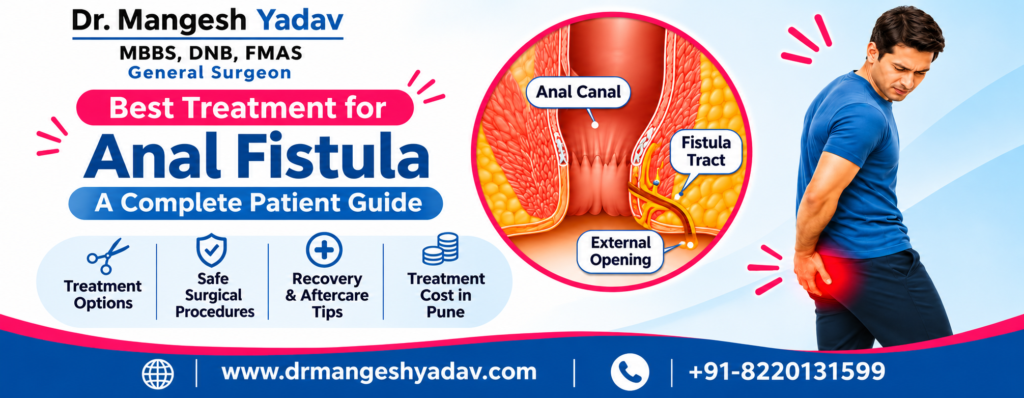
A fistula is a small tunnel that forms between the inside of the anal canal and the skin outside the anus. It usually starts as an infected anal gland that turns into an abscess (a painful pus-filled swelling). When that abscess bursts or is drained, it can leave behind a tract that keeps leaking pus or blood.
Anal fistula causes and risk factors:
- A previous anal abscess (the most common cause — roughly half of anal abscesses go on to form a fistula)
- A sedentary lifestyle and long hours of sitting
- Obesity and high BMI
- Diabetes
- Smoking and alcohol
- Long toilet sitting during bowel movements
- Chronic diarrhoea, Crohn’s disease, or previous anal surgery
A case–control study in Techniques in Coloproctology listed sedentary lifestyle, rare participation in sports, and prolonged sitting on the toilet among the independent risk factors for anal fistula. So the desk-job story isn’t only about piles.
Signs of a fistula: a recurring boil near the anus, pus or blood-stained discharge that stains your underwear, pain while sitting, and skin irritation around the opening.
Can a fistula be treated without surgery?
This is one of the most searched questions, so let’s be honest. Many people look for fistula treatment without surgery in the hope that creams or antibiotics will close it. Medicines can calm the infection and pain for a while, but they rarely heal the tract itself, which is why fistulas tend to come back. What has changed is that treatment no longer has to mean a big open operation. Minimally invasive options like laser fistula treatment (FiLaC), VAAFT and seton/Kshar Sutra-based methods are designed to close the tract with less pain, smaller wounds, faster recovery and better protection of the sphincter muscle that controls continence.
The best treatment for anal fistula depends on how deep the tract runs, how many branches it has, and whether it involves the sphincter muscle which is why an MRI fistulogram and a proper examination come first. Our detailed guide on the best treatment for anal fistula walks you through each option.
If you’re looking for anal fistula treatment in Pune, it’s worth consulting a surgeon who handles both simple and complex fistulas regularly. You can learn more about our approach on the anal fistula treatment in Hadapsar, Pune page. And if budget is on your mind, our breakdown of the fistula treatment cost in Pune — what’s covered and what’s not — explains how the technique, hospital and insurance affect the final bill.
Early Warning Signs Desk Workers Ignore
Most people live with symptoms for months sometimes years out of embarrassment or the hope that it’ll “settle on its own.” The early warning signs to watch for are:
- Bright red blood on the toilet paper or in the pan after motion
- Itching or irritation around the anus, especially after long sitting
- A soft lump near the anus that appears during straining
- Discomfort or a dull ache while sitting in your office chair
- A feeling that your bowel hasn’t fully emptied
- Mucus discharge or dampness around the anus
- Sharp pain while passing stool (possible fissure)
- A boil near the anus that keeps coming back or leaks pus (possible fistula)
How to Prevent Piles If You Have a Sitting Job
You don’t have to quit your job. Small, consistent changes make a big difference.
At your desk
- Follow the 30–60 rule. Stand up every 30–60 minutes and walk for 2–3 minutes to the water cooler, the washroom, or just around the floor. Set a phone or laptop reminder if needed.
- Take calls on your feet. Walking meetings and standing phone calls add up.
- Sit right. Keep your feet flat, knees at hip level, and back supported. Avoid slouching deep into the chair, which rolls weight onto the tailbone and anal area.
- Choose the right cushion. A firm, supportive cushion or a gel/coccyx cushion helps spread weight. Avoid donut-shaped rings for long use they can let the area sag and increase swelling.
- Try a standing desk for part of the day if your office allows it.
On your plate
- Aim for about 25–30 g of fibre a day — whole wheat roti, jowar or bajra bhakri, dal, rajma, chana, fruits like papaya, guava, pear and apple (with skin), and plenty of vegetables and salad.
- Psyllium husk (isabgol) in water at night is a simple, time-tested helper for regular motions.
- Cut back on maida, deep-fried snacks, very spicy food, excess red meat, and processed foods.
- Limit tea, coffee and alcohol, which can dehydrate you.
Water and timing
- Drink 8–10 glasses of water a day. Keep a bottle on your desk — if it’s still full at 4 pm, you’ve got your answer.
- Don’t skip meals or eat at random times; a regular routine helps regular bowel habits.
In the washroom
- Go when you feel the urge. Don’t hold it for the next meeting.
- Keep it to 3–5 minutes. Leave your phone outside.
- Don’t strain. If nothing happens, get up and try later.
- Use a small footstool under your feet on a Western toilet. It mimics the squatting position and straightens the rectum, making motion easier.
- Keep the area clean and dry, especially in Pune’s humid monsoon months — this also lowers the chance of infection and abscess.
Move more outside work
- A 30-minute brisk walk daily (or 150 minutes a week) is one of the best things you can do for your gut and veins.
- Simple exercises like squats, walking lunges, cycling, swimming and yoga poses such as Pawanmuktasana, Malasana and Vajrasana (after meals) support digestion and pelvic circulation.
- Pelvic floor exercises (Kegels) improve blood flow and muscle tone in the area.
- Manage your weight — extra weight adds pressure on the rectal veins every time you sit.
For a deeper look at lifestyle triggers specific to men, see our article on causes of piles in men.
Treatment Options for Piles
If symptoms have already begun, don’t panic, most piles are very treatable & many don’t need surgery at all.
- Grade I–II piles usually respond to diet changes, stool softeners, sitz baths (sitting in warm water for 10–15 minutes) and medicines prescribed by your doctor. Read more in can piles be treated without surgery?
- In-clinic procedures like rubber band ligation or sclerotherapy can help selected internal piles.
- Grade III–IV, large or recurring piles are often best treated with laser piles surgery — a day-care procedure with no open wound, minimal bleeding, and most people back at their desk within a few days. Learn more about laser piles treatment in Pune and the piles surgery cost in Pune.
- Fissures often heal with medicines and diet, while chronic ones may need laser fissure treatment.
- Fistulas need a proper evaluation and a procedure tailored to the tract, as explained above.
One important point: after any treatment, the same sitting habits can bring piles back. Prevention isn’t a one-time fix it’s how you protect the result.
Why Patients Trust Dr. Mangesh Yadav
Dr. Mangesh Yadav is a General, Laparoscopic & Robotic Surgeon in Pune with over 15 years of surgical experience and a focused practice in piles, fissures and fistulas. Many of his patients are working professionals from Hadapsar, Magarpatta, Kharadi, Loni Kalbhor and nearby areas who need effective treatment with minimal time away from work.
- MBBS — Rajiv Gandhi Medical College, Thane
- DNB (General Surgery) — St. Isabel Hospital, Chennai (National Board of Examinations)
- FMAS — Fellowship in Minimal Access Surgery, KEMH, Mumbai
- Visiting Grant Fellow, Seoul National University Hospital (2016)
- Recipient of the Noble Young Surgeon Achievement Award
- Practises at Vishwaraj Hospital, Pune–Solapur Road, Loni Kalbhor, and his Hadapsar clinic
As a fistula specialist in Pune and an experienced piles surgeon, Dr. Yadav starts every treatment plan with an honest assessment: whether diet and medicines will be enough, or whether a minimally invasive procedure like laser treatment will give you a better, longer-lasting result. Surgery is recommended only when it truly helps.
Frequently Asked Questions
Can sitting for long hours cause piles?
Sitting for long hours doesn’t directly cause piles on its own, but it significantly increases the risk. Continuous sitting puts pressure on the veins around the anus, slows blood flow, and often leads to constipation and straining — the main triggers for piles. Studies suggest sitting 5 or more hours a day raises the risk of piles and fissures.
Why are piles increasing among young people in India?
young Indians mainly because of desk jobs, long commutes, work-from-home habits, low-fibre diets, low water intake, and using phones on the toilet. Nearly half of Indian adults don’t get enough physical activity, which slows digestion and adds pressure on rectal veins.
How many hours of sitting is too much for piles?
Research links sitting for 5 or more hours a day with a higher risk of piles and anal fissures. More than the total hours, the problem is sitting continuously — standing up and walking for 2–3 minutes every 30–60 minutes helps reduce pressure on the anal veins.
What is the best sitting position to prevent piles?
Sit with your back supported, feet flat on the floor, and knees roughly at hip level. Avoid slouching or sitting on very soft sofas for long. A firm or coccyx cushion helps spread weight; donut cushions are best avoided for long use.
What are the main causes of anal fistula?
The most common cause is an infection in an anal gland that develops into an abscess. Other possible causes include Crohn’s disease, certain infections such as tuberculosis, and previous surgery or injury involving the anal region.
Can a desk job cause anal fistula?
A desk job alone doesn’t directly cause anal fistula, but a sedentary lifestyle and prolonged sitting are recognised risk factors. Most fistulas start from an infected anal gland that forms an abscess; obesity, diabetes, smoking and long toilet sitting also raise the risk.
Is fistula treatment without surgery possible?
Medicines and antibiotics can control infection and pain, but they rarely close a fistula tract permanently, so the problem usually returns. Minimally invasive options like laser fistula treatment (FiLaC), VAAFT and seton or Kshar Sutra methods offer effective treatment with less pain and faster recovery than traditional open surgery.
What is the fistula treatment cost in Pune?
Fistula treatment cost in Pune depends on the type of fistula (simple or complex), the technique used (laser, VAAFT, seton, or open surgery), hospital charges, and insurance coverage. A consultation and MRI fistulogram help your surgeon give an accurate estimate