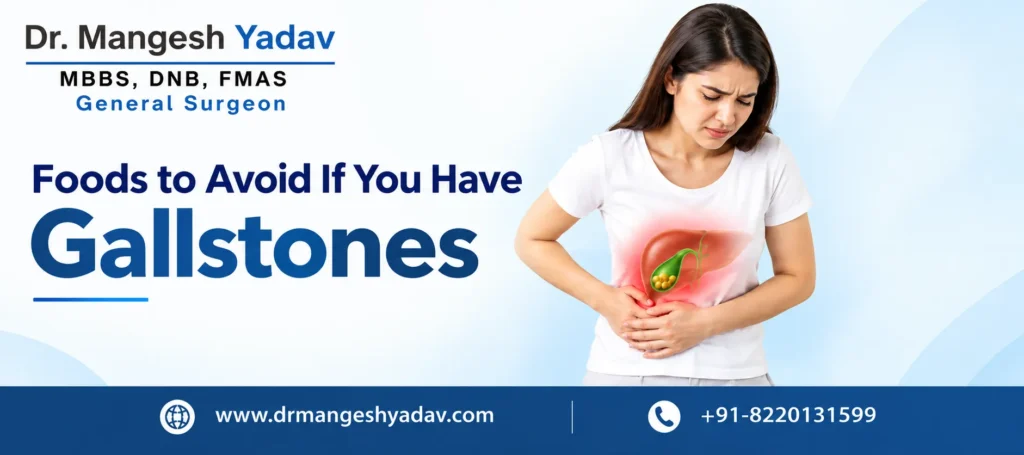
Foods to Avoid If You Have Gallstones
- Home
- Hernia Care
- Foods to Avoid If You Have Gallstones
Foods to Avoid If You Have Gallstones
Written & Medically Reviewed By:
Dr. Mangesh Yadav
General, Laparoscopic & Robotic Surgeon
15+ Years of Surgical Experience
6,000+ Piles Cases Treated
Table of Contents
That dull ache under your right ribs after a plate of puri-bhaji is not always “just acidity.” For many people, it is the first sign of gallstones. Food does not create stones overnight, but it can decide how often they bother you. This guide covers the gallstones diet in plain language: what to avoid, what to eat, and how to eat after gallbladder surgery.
Overview
If you have gallstones, limit fried foods, fatty meats, butter, cream, full-fat dairy, fast food, chips and pastries. Choose fruits, vegetables, whole grains and lean proteins instead. A balanced diet may help manage symptoms, but consult a doctor for proper treatment. Severe abdominal pain, fever or jaundice requires urgent medical attention.
Why Diet Matters When You Have Gallstones
Your gallbladder stores bile, a fluid that helps you digest fat. When you eat something oily, the gallbladder squeezes to release bile. If a stone is in the way, that squeeze can cause pain.
So the logic is simple. Less fat at one sitting means less squeezing, and fewer painful episodes.
Diet cannot dissolve stones already formed. If you are wondering whether stones can go away on their own, read our guide on whether gallstones can disappear without surgery. Diet can reduce symptoms while you and your doctor decide on the next step.
Gallstones: Foods to Avoid
Not every person reacts to every food. Still, these are the usual triggers.
1. Deep-Fried Foods
Samosa, pakora, puri, bhature, french fries, fried chicken. Hot oil makes a heavy fat load that the gallbladder must deal with quickly.
2. Fatty and Red Meat
Mutton, organ meats, sausages, bacon and fatty cuts take longer to digest and carry a lot of saturated fat.
3. Full-Fat Dairy and Rich Gravies
Cream, butter, malai, cheese-heavy dishes and paneer butter masala-style gravies pack fat into a single meal.
4. Excess Ghee, Butter and Coconut-Based Curries
A small amount may be fine for some people. A generous spoon on every roti is a different story.
5. Packaged and Bakery Foods
Biscuits, cakes, pastries, namkeen, instant noodles, and packaged snacks often contain hidden fats, including trans fats.
6. Refined Carbohydrates and Sugary Sweets
Maida products, white bread, jalebi, gulab jamun, and sugary drinks. Diets high in refined sugar are linked with a higher risk of gallstone formation in studies.
7. Crash Diets and Skipped Meals
This one surprises people. Very rapid weight loss, or long gaps between meals, can make stones more likely. Steady, gradual weight loss is safer.
Common Indian Foods That May Trigger Symptoms
- Paratha cooked with extra ghee or oil
- Puri-chole, bhature, kachori
- Butter chicken, malai kofta, shahi paneer
- Biryani cooked with a lot of oil or ghee
- Mithai made with khoya and ghee
- Street-style fried snacks
Keep a simple food diary for two weeks. Note what you ate and when pain started. Patterns show up quickly.
Not sure if your pain is from the gallbladder at all? Our comparison of gallstones symptoms vs kidney stones explains how the two differ.
Gallstones Low Fat Diet: What You Can Eat
A gallstones low fat diet does not mean boring food. It means choosing lighter cooking and balanced plates.
- Whole grains: roti from whole wheat, brown rice, oats, jowar, bajra, daliya
- Vegetables: most cooked vegetables, salads, leafy greens
- Fruits: apple, papaya, pomegranate, banana, orange
- Protein: dal, moong, sprouts, egg white, skinless chicken, fish in small portions
- Dairy: low-fat milk, curd and buttermilk
- Fibre: a fibre-rich diet is generally helpful for digestion
Cooking Methods That Help
Steam, boil, grill, roast or pressure cook. Use measured oil rather than pouring from the bottle. Eat smaller meals more often instead of two heavy ones.
Sample Gallstone Diet Chart
This is a general example for education. Your own plan should come from your doctor or a registered dietitian.
Meal | Example |
Early morning | Warm water, or 1 cup green tea |
Breakfast | Vegetable poha or oats upma, 1 fruit, low-fat milk |
Mid-morning | Buttermilk or 1 fruit |
Lunch | 2 phulka (no ghee), dal, cooked vegetable, salad, 1 small bowl curd |
Evening | Roasted chana or a small bowl of sprouts |
Dinner | Vegetable khichdi or 2 roti with lauki or tinda sabzi, dal soup |
Bedtime | 1 cup low-fat milk, if it suits you |
Post Gallstone Surgery Diet
Many people with symptomatic gallstones have the gallbladder removed (cholecystectomy). You can read more about gallbladder removal surgery in Pune and when it is advised. Your body keeps digesting food without the gallbladder. Bile now flows directly from the liver to the intestine in a steady trickle rather than in a stored burst.
That is why fatty food can feel heavy for a while. Recovery speed differs from person to person, so follow your surgeon’s instructions first.
A General Recovery Pattern
- First few days: clear liquids, then light foods such as khichdi, dal water, curd rice, banana, toast
- First few weeks: low-fat, small, frequent meals; add foods one at a time
- Later: most people slowly return to a normal balanced diet, still avoiding excess grease
What Foods to Avoid After Gallbladder Removal
These commonly cause loose stools, gas, bloating or discomfort in the early weeks:
- Fried and greasy foods
- Very oily or creamy gravies
- Fatty meats and processed meats
- Full-fat dairy in large amounts
- Very spicy food, if it upsets you
- Large heavy meals
- Excess caffeine or fizzy drinks, if they cause bloating
If a food bothers you, pause it and try again after a couple of weeks.
Week 1: Light and Gentle
Eat 5 to 6 small meals instead of 3 big ones. Keep food soft, warm and low in fat.
Day | Breakfast | Lunch | Evening | Dinner |
Day 1 | Sips of water or clear fluids, only as your surgeon allows | Dal water (thin, strained) if allowed | Clear fluids | Dal water or a small portion of thin khichdi if tolerated |
Day 2 | Rice kanji (thin rice water) + a few banana slices | Dal water + a few spoons of soft moong dal khichdi | Papaya, a few pieces | Curd rice, small bowl |
Day 3 | Soft moong dal khichdi, small bowl | Khichdi + boiled lauki | Banana | Curd rice + boiled carrot |
Day 4 | Rice kanji + banana | Khichdi + boiled vegetables | Papaya | Clear vegetable soup + curd rice |
Day 5 | Soft khichdi, small bowl | Dal water + curd rice + boiled vegetables | Banana or papaya | Moong dal khichdi |
Day 6 | Banana + dal water | Khichdi + boiled lauki or tori | Papaya | Curd rice + boiled vegetables |
Day 7 | Soft khichdi | Curd rice + boiled vegetables + dal water | Banana | Moong dal khichdi |
Weeks 2 to 4: Slowly Widening the Plate
Rotate this 7-day pattern for three weeks. Add only one new food at a time, and keep a note if anything causes gas, bloating or loose stools.
Day | Breakfast | Lunch | Evening | Dinner |
Day 1 | Oats porridge cooked in water | 2 phulka (no ghee) + dal + lauki sabzi | Buttermilk + banana | Moong dal khichdi |
Day 2 | 2 steamed idli + plain sambar | Phulka + tori sabzi + curd | Papaya | Curd rice + boiled vegetables |
Day 3 | Oats upma (little oil) | Phulka + dal + boiled vegetable | Buttermilk | Vegetable khichdi |
Day 4 | 2 idli + coconut-free chutney | Phulka + lauki sabzi + boiled egg white | Fruit (apple or papaya) | Dal soup + 1 phulka |
Day 5 | Oats with banana slices | Phulka + dal + tori sabzi | Buttermilk | Curd rice + sautéed vegetables (minimal oil) |
Day 6 | Vegetable poha, very little oil | Phulka + dal + bottle gourd sabzi | Boiled egg white or papaya | Moong khichdi + curd |
Day 7 | 2 steamed idli + sambar | Phulka + vegetable sabzi + buttermilk | Banana | Vegetable soup + 1 phulka |
After 4 to 6 Weeks: Returning to Variety
Most people begin trying regular foods in small portions. A sample day:
Meal | Example |
Early morning | Warm water |
Breakfast | Vegetable poha or upma, 1 fruit |
Mid-morning | Buttermilk or a fruit |
Lunch | 2 roti (little or no ghee), dal, 2 vegetables, salad, curd |
Evening | Roasted chana or sprouts |
Dinner | Roti with sabzi and dal, or vegetable khichdi |
- Introduce one regular food at a time, such as a small piece of paneer, a spoon of ghee or a plain paratha.
- Keep oil measured, and avoid deep-fried foods and heavy gravies as much as you can.
- If a food causes discomfort, pause it for a couple of weeks and try again.
Throughout recovery:
- Drink water regularly through the day.
- Walk gently after meals if your surgeon allows.
- Call your doctor if you have severe pain, fever, vomiting, yellowing of eyes or skin, or persistent loose stools.
When to See a Doctor Without Delay
Get medical help promptly if you notice:
- Severe pain in the upper right abdomen lasting more than a few hours
- Fever with chills
- Yellowing of the eyes or skin
- Dark urine or pale stools
- Repeated vomiting
These may point to a complication that needs urgent assessment. Persistent abdominal pain or lumps should always be examined, and some digestive problems that do not settle with medicines fall under gastrointestinal surgical conditions. If you live in or near Hadapsar, Pune, consult a registered doctor in your area for an in-person evaluation.
Conclusion
The core of a gallstones diet is easy to remember: cut back on fried, fatty and sugary foods, eat smaller regular meals, and choose fibre-rich, lightly cooked food. After surgery, go slowly and reintroduce foods one by one.
Frequently Asked Questions
Can diet remove gallstones?
No. Diet may ease symptoms, but it does not reliably dissolve existing stones. Your doctor will advise on treatment.
Is ghee completely banned?
Not always. Quantity matters. Ask your doctor how much suits you.
Do I need a special diet forever after surgery?
Most people do not. A balanced, moderate-fat diet usually works well in the long run.
Can I eat eggs if I have gallstones?
Egg whites are usually well tolerated because they are low in fat. Egg yolks contain fat, so some people find them heavy. Try a small portion and watch how you feel, or ask your doctor or dietitian.
Is milk or curd safe with gallstones?
Low-fat milk, curd and buttermilk are generally preferred over full-cream milk, malai and cheese. Choose the low-fat versions and keep portions moderate.
Can I drink tea or coffee with gallstones?
Many people tolerate a cup or two without trouble. If tea or coffee with a lot of milk and sugar brings on discomfort, cut back. Avoid taking it on an empty stomach if it upsets you.
How soon can I eat normal food after gallbladder removal?
Most people start with liquids and light food soon after surgery, as advised by their surgeon. Moving back to a regular balanced diet usually happens gradually over several weeks. Follow your own surgeon’s plan, since timing depends on the surgery and your recovery.
Is loose motion normal after gallbladder removal?
Loose stools can happen in some people, especially after fatty meals, because bile now reaches the intestine continuously. It often settles with time and lighter meals. If it is severe, lasts for weeks, or comes with fever or weight loss, see your doctor.