
Appendicitis Symptoms in Adults | Don’t Ignore These Warning Signs
- Home
- Hernia Care
- Appendicitis Symptoms in Adults | Don’t Ignore These Warning Signs
Appendicitis Symptoms in Adults | Don't Ignore These Warning Signs

Written & Medically Reviewed By:
Dr. Mangesh Yadav
General, Laparoscopic & Robotic Surgeon
15+ Years of Surgical Experience
6,000+ Piles Cases Treated
Table of Contents
A dull ache near your belly button. You blame last night’s dinner. By evening, the pain has shifted lower on the right side, and even a cough makes you wince.
This pattern is one of the best-known appendicitis symptoms in adults. This guide explains what to watch for, what can look different, and when waiting becomes risky.
The most common sign of appendicitis in adults is abdominal pain that starts around the navel and moves to the lower right abdomen over several hours, often with loss of appetite, nausea, and low-grade fever. Pain that keeps worsening needs urgent medical evaluation.
Overview
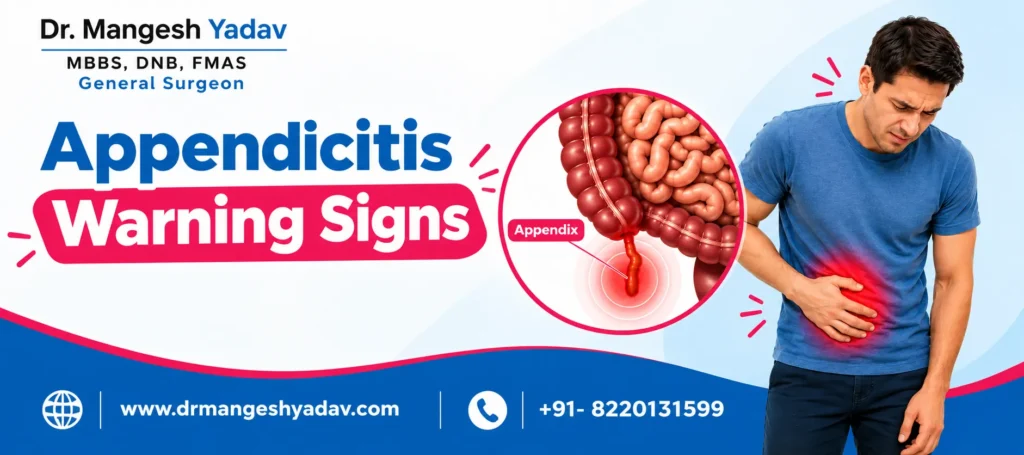
Appendicitis symptoms in adults often include sudden pain around the belly button that moves to the lower right abdomen, nausea, vomiting, loss of appetite, fever, and abdominal swelling. The pain may worsen with movement, coughing, or sneezing. Do not ignore these warning signs. Seek urgent medical attention if appendicitis is suspected, as prompt treatment can help prevent serious complications.
What Is Appendicitis?
Appendicitis is inflammation of the appendix, a small finger-shaped pouch attached to the large intestine on the lower right side of the abdomen.
It usually begins when the opening of the appendix gets blocked, often by hardened stool or swollen lymphatic tissue. Bacteria multiply inside, and the appendix becomes inflamed and swollen.
Why timing matters: If the inflamed appendix is not treated, it can burst. A rupture spreads infection into the abdominal cavity and makes treatment more complicated.
Appendicitis can occur at any age. It is most often diagnosed between the teens and the early thirties, but adults in their 40s, 50s, and beyond are not exempt.
Appendicitis Pain Symptoms in Adults | The Classic Pattern
Pain is the signal most people notice first. Doctors look closely at how it behaves, not just where it hurts.
Stage 1: Vague pain around the navel
The initial discomfort is often dull and poorly localised. It may feel like cramping or indigestion.
Stage 2: Pain shifts to the lower right abdomen
Within roughly 12 to 24 hours, the pain commonly settles in the lower right side. It becomes sharper and more constant.
Doctors call the tender spot McBurney’s point. Pressing there, or releasing pressure suddenly, often hurts more.
Stage 3: Pain gets worse with movement
You may notice that these actions make it worse:
- Coughing or sneezing
- Walking, especially quickly
- Going over a speed bump in a vehicle
- Taking a deep breath
- Lying flat or straightening your legs
Many people end up curled up on one side because it is the only comfortable position.
Signs and Symptoms of Appendicitis in Adults
Pain rarely arrives alone. Look for these companions:
- Loss of appetite. This is very common. Being unable to face food, even a favourite meal, is a useful clue.
- Nausea and vomiting. These usually begin after the pain starts, not before.
- Low-grade fever. Typically around 37.5 to 38.5°C (99.5 to 101.3°F). A higher fever can suggest the infection is spreading.
- Abdominal swelling or bloating.
- Constipation or diarrhoea. Some people cannot pass gas or stool; others have loose motions.
- A general unwell feeling. Tiredness, chills, and weakness often come along.
No single symptom confirms appendicitis. It is the combination and the progression that raises concern.
Why Symptoms Can Look Different
Textbook symptoms are a guide, not a guarantee. The appendix does not sit in exactly the same spot in every person.
Pain in the back, flank, or pelvis
If the appendix lies behind the large intestine, pain may be felt in the right flank or lower back. If it points toward the pelvis, you may have lower abdominal pain, a frequent urge to pass urine or loose stools.
Appendicitis in older adults
Older adults can have milder pain, little or no fever, and a less dramatic story. This is one reason diagnosis can be delayed. Any new or persistent abdominal pain in an older person deserves a prompt check.
Appendicitis during pregnancy
As the uterus grows, the appendix is pushed upward. Pain may be felt higher on the right side. Abdominal pain in pregnancy should always be assessed by a doctor.
Symptoms that mimic other conditions
Several problems can feel similar, including gallstones, kidney stones, hernia complications, ovarian cysts, and gastroenteritis. Our article on gallstone symptoms versus kidney stones shows how abdominal pain differs by cause.
This overlap is exactly why self-diagnosis is unreliable.
Appendicitis Warning Signs | When to Seek Emergency Care
Go to a hospital emergency department without delay if you have:
- Abdominal pain that is severe, sudden, or steadily worsening
- Pain in the lower right abdomen with fever and vomiting
- A hard, rigid belly or pain when the abdomen is touched lightly
- Fast heartbeat, shivering, or feeling faint
- Inability to pass stool or gas along with swelling
For a deeper look at the red flags, read our guide on appendicitis warning signs and when abdominal pain is a surgical emergency.
What Not to Do While You Wait
Some well-meant home steps can make things harder for the doctor, or worse for you.
- Do not take strong painkillers repeatedly to “settle” the pain. They can mask symptoms.
- Do not use laxatives or enemas.
- Do not apply a hot water bag to the abdomen.
- Do not eat or drink heavily if you may need surgery. Sip water only until you are assessed.
How Is Appendicitis Treated?
Treatment depends on how advanced the inflammation is and your overall health.
- Appendectomy (surgical removal) is the standard treatment. It is commonly performed by laparoscopic (keyhole) surgery through small incisions, and many patients go home within a day or two.
- Antibiotics alone have been studied for selected cases of uncomplicated appendicitis. Your surgeon will decide this, because some people later need surgery.
- Drainage and antibiotics may be needed first if an abscess has formed.
Recovery time varies by surgery type and individual. Your surgeon will explain what to expect in your case.
You can read about the approach to care on our appendicitis treatment page in Hadapsar.
Can Appendicitis Be Prevented?
There is no proven way to prevent it. Some studies link a fibre-rich diet with lower risk, but the evidence is not conclusive.
What you can control is how fast you respond. Recognising the pattern early often makes the difference between a straightforward procedure and a complicated one.
If you have recurring or unexplained belly pain, see our overview of abdominal pain and lumps treatment, or learn about other gastrointestinal surgical conditions that can cause similar discomfort.
Appendicitis Symptoms in Adults
Feature | What it often looks like |
First pain | Dull ache near the navel |
Later pain | Sharp, constant, lower right abdomen |
Worsened by | Coughing, walking, deep breaths |
Appetite | Reduced or absent |
Digestive signs | Nausea, vomiting, bloating, altered stools |
Fever | Low-grade early; higher if infection spreads |
Urgency | Seek care promptly; do not wait it out |
Conclusion
Appendicitis often starts quietly, with a dull ache near the navel that is easy to blame on a heavy meal. Within hours, the pain usually moves to the lower right abdomen, becomes sharper, and gets worse with coughing, walking, or deep breaths. Loss of appetite, nausea, and a low-grade fever commonly follow. Symptoms can look different in older adults, during pregnancy, or when the appendix sits in an unusual position, so the pattern matters more than any single sign.
Frequently Asked Questions
What are the first signs of appendicitis in adults?
Early signs are usually dull pain around the navel, loss of appetite, and mild nausea. Over several hours, the pain tends to move to the lower right abdomen and sharpen.
How long can appendicitis pain last before the appendix bursts?
There is no fixed time. Risk of rupture generally rises after the first 24 to 48 hours of symptoms, but it can happen sooner or later. Do not wait to see how long it lasts.
Can appendicitis pain come and go?
Early or mild inflammation may cause pain that fluctuates. Repeated episodes of right-sided abdominal pain still need medical evaluation, as they can signal ongoing inflammation.
Can you have appendicitis without a fever?
Yes. Fever is common but not universal, particularly in older adults. Absence of fever does not rule out appendicitis.
Is appendicitis in adults different from appendicitis in children?
The core condition is the same, but adults often have more varied presentations and more conditions that mimic it. Older adults may show subtler signs. This article is written for adults and is not intended as guidance for children.