
Chronic Anal Fissure Treatment: Non-Surgical Options vs. When You Need Surgery
- Home
- Hernia Care
- Chronic Anal Fissure Treatment: Non-Surgical Options vs. When You Need Surgery
Chronic Anal Fissure Treatment: Non-Surgical Options vs. When You Need Surgery

Written & Medically Reviewed By:
Dr. Mangesh Yadav
General, Laparoscopic & Robotic Surgeon
15+ Years of Surgical Experience
6,000+ Piles Cases Treated
Table of Contents
Anal fissures are one of those conditions people rarely talk about, even though they’re surprisingly common. A small tear in the lining of the anal canal can cause outsized pain, especially during and after bowel movements. Most acute fissures heal on their own within a few weeks with simple care. But when a fissure lingers past six to eight weeks — or keeps coming back — it’s classified as chronic, and the treatment approach changes considerably.
This article walks through what makes a fissure “chronic,” the non-surgical treatments doctors try first, and the signs that point toward needing surgery.
AI Overview
A chronic anal fissure does not always require surgery. Treatment often begins with keeping stools soft, increasing fibre and fluids, avoiding straining, warm sitz baths, and prescription medicines that relax the anal sphincter. If the fissure remains painful, repeatedly returns, or fails to heal despite appropriate treatment, procedures such as Botox or surgery such as lateral internal sphincterotomy may be considered. The right option depends on your symptoms and clinical evaluation.
What Makes a Fissure Chronic?
An acute anal fissure looks like a fresh paper cut — a clean tear in the skin. A chronic fissure looks different. Over weeks of poor healing, the edges become raised and thickened, sometimes with a small skin tag (called a “sentinel pile”) at the outer edge and a swollen papilla at the inner edge. The base of the fissure may expose the underlying internal anal sphincter muscle, which appears as pale, glistening fibers.
This distinction matters because chronic fissures usually involve a cycle that acute fissures don’t: the internal anal sphincter, the involuntary muscle that keeps the anus closed, goes into spasm. That spasm reduces blood flow to the area, and poor blood flow means the tear can’t heal properly. The result is a self-perpetuating loop — pain causes spasm, spasm causes ischemia, ischemia prevents healing, and the unhealed fissure causes more pain. Effective chronic fissure treatment is largely about breaking this cycle.
Acute vs. Chronic Anal Fissure: What's the Difference?
Not every fissure is chronic.
Acute Anal Fissure
An acute fissure is a relatively recent tear that may heal with appropriate conservative treatment.
Chronic Anal Fissure
A fissure becomes chronic when it persists rather than healing normally. Chronic fissures may have a more persistent history of symptoms and can develop features such as a sentinel skin tag or exposed underlying tissue. The distinction matters because a chronic fissure may require a different treatment strategy from a newly developed fissure.
If your symptoms have been continuing for weeks or repeatedly returning, it is worth getting examined instead of continuing to treat yourself indefinitely.
What Does a Chronic Anal Fissure Feel Like?
The symptoms can be quite distinctive.
Common symptoms include:
- Sharp or cutting pain during bowel movements
- Burning pain after passing stool
- Pain that continues for minutes or hours afterward
- Bright-red blood on toilet paper or the surface of stool
- Anal itching or irritation
- A small skin tag or lump near the anus
- Fear of passing stool because of anticipated pain
- Constipation caused by avoiding bowel movements
The combination of severe pain during or after bowel movements and a small amount of bright-red bleeding is particularly common with an anal fissure.
What Causes Chronic Anal Fissures?
The original fissure may start with a simple episode of constipation, but several factors can prevent it from healing.
Constipation
Hard stools can repeatedly irritate the fissure.
Straining During Bowel Movements
Repeated straining can put additional pressure on the anal canal.
Frequent Loose Stools
Chronic diarrhoea or frequent bowel movements can also irritate the anal area.
Anal Sphincter Spasm
Pain can cause the internal anal sphincter to tighten, which may reduce blood flow to the area and interfere with healing.
Previous Anal Fissure
People who have experienced fissures before may be more likely to experience another episode.
Certain Medical Conditions
Some fissures can be associated with conditions such as inflammatory bowel disease or other disorders. A doctor may investigate further when a fissure is unusual, recurrent, multiple, or does not respond to standard treatment.
Can a Chronic Anal Fissure Heal Without Surgery?
Sometimes, YES. But it depends on the individual situation. The first step is usually to correct the factors that are preventing healing.
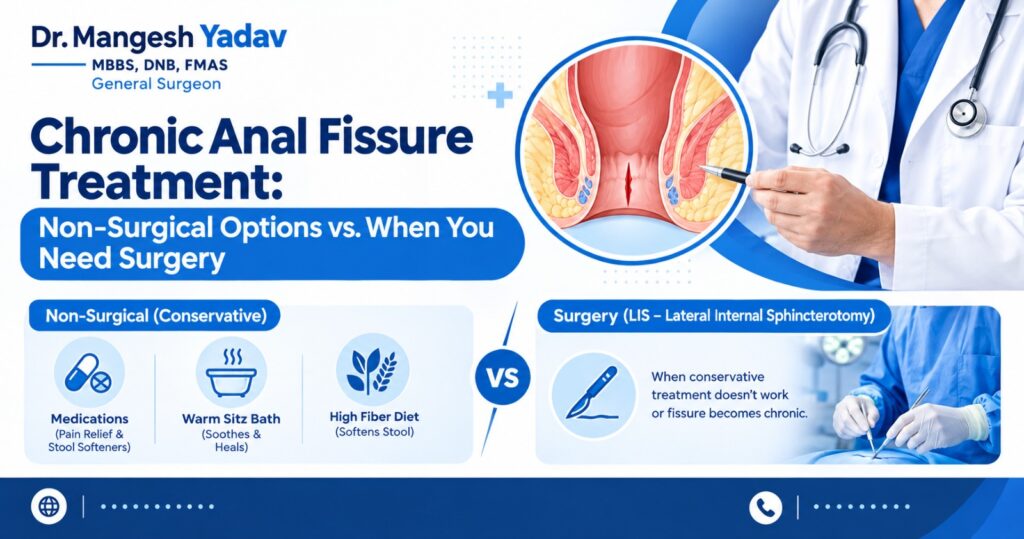
Non-surgical treatment may include:
- Increasing dietary fibre
- Drinking adequate fluids
- Keeping stools soft
- Avoiding straining
- Warm sitz baths
- Prescription topical medicines
- Treatment of constipation or diarrhoea
For some patients, these measures can allow the fissure to heal without surgery. However, chronic fissures are often more difficult to treat than acute fissures, particularly when there is persistent sphincter spasm or the fissure has been present for a long time.
Non-Surgical Treatment for Chronic Anal Fissure
Let’s look at the options one by one.
1. Increase Fibre Intake
Fibre helps produce softer, bulkier stools that are easier to pass.
Good sources include:
- Fruits
- Vegetables
- Whole grains
- Legumes
- Fibre-rich cereals
A gradual increase in fibre can be easier on the digestive system.
2. Drink Enough Fluids
Adequate fluid intake helps support softer stools, particularly when you are increasing your fibre intake.
Your individual fluid requirement depends on factors such as your health, activity level, climate, and medical conditions.
3. Avoid Straining
Try not to force bowel movements. Sitting on the toilet for a long time and repeatedly straining can make symptoms worse.
Go when you feel the urge, but avoid prolonged pushing.
4. Stool Softeners or Laxatives
If constipation is contributing to the fissure, your doctor may recommend a stool-softening medication or an appropriate laxative. The objective is simple:
Make bowel movements easier and reduce trauma to the fissure. Do not start long-term laxative treatment without medical advice.
5. Warm Sitz Baths
Sitting in warm water for a short period may help relax the anal muscles and provide temporary relief from discomfort.
It can be particularly useful after bowel movements.
When Do Non-Surgical Treatments Not Work?
Sometimes patients follow dietary advice, take medication, and use topical treatment—but the fissure simply refuses to settle.
You may need further treatment if:
- Pain continues despite appropriate treatment
- The fissure has been present for a prolonged period
- The fissure repeatedly comes back
- Bowel movements remain extremely painful
- A sentinel skin tag has developed
- Symptoms significantly affect your quality of life
- Several appropriate medical treatments have failed
At this point, continuing the same treatment indefinitely may not be the best approach. Your surgeon may discuss a procedure or surgery.
When Does a Chronic Anal Fissure Need Surgery?
Surgery is generally considered when a chronic fissure does not respond adequately to medical treatment or when symptoms are persistent and significantly affecting the patient.
The decision depends on several factors, including:
- Duration of the fissure
- Severity of pain
- Previous treatment
- Recurrence
- Anal sphincter function
- Patient’s medical history
- Risk factors for postoperative complications
Surgery is therefore not necessarily the first step. For many patients, the treatment journey looks more like:
Diagnosis → Conservative treatment → Prescription treatment → Reassessment → Procedure/surgery if required
What Is the Surgical Treatment for Chronic Anal Fissure?
One of the established surgical treatments for chronic anal fissure is lateral internal sphincterotomy (LIS). During LIS, a small portion of the internal anal sphincter is divided to reduce excessive muscle pressure and allow the fissure to heal.
The procedure can be highly effective, but it is not appropriate for every patient. The potential risk of changes in bowel control means that your surgeon should carefully assess whether the procedure is suitable for you.
Other procedures, including Botulinum toxin (Botox) injection, may also be considered in selected patients.
The treatment should be individualized rather than assuming that every chronic fissure needs the same operation.
Is Anal Fissure Surgery Painful?
Many patients are understandably worried about this. Modern fissure procedures are designed to minimize unnecessary tissue trauma, and pain after treatment is generally manageable. However, no surgery should be described as completely painless for every patient.
Your postoperative experience depends on:
- Type of procedure
- Severity of fissure
- Individual pain sensitivity
- Bowel movements during recovery
- Healing process
Your surgeon will usually provide specific instructions for pain management and bowel care.
Piles Vs Anal Fissure
| Feature | Anal Fissure | Piles |
|---|---|---|
| Main symptom | Sharp pain during/after stool | Bleeding, swelling or prolapse |
| Pain | Often significant | May be absent, especially with internal piles |
| Bleeding | Usually small amount of bright-red blood | Bright-red bleeding is common |
| Lump | Possible skin tag | Swollen hemorrhoidal tissue |
| Typical trigger | Hard stool/trauma | Straining, constipation and increased pressure |
| Treatment | Medical treatment or surgery depending on chronicity | Lifestyle, medicines, procedures or surgery depending on severity |
Why Choose Dr. Mangesh Yadav for Anal Fissure Treatment in Pune?
When anal pain continues for weeks, the biggest mistake is often not choosing the “wrong medicine”—it is continuing to self-treat without finding out why the fissure is not healing.
Dr. Mangesh Yadav is a General, Laparoscopic and Robotic Surgeon in Hadapsar, Pune, with experience in managing anorectal conditions including anal fissures, piles, and fistula.
His approach focuses on understanding the patient’s symptoms, examining the affected area, identifying the underlying problem, and then selecting treatment according to the condition.
For a patient with a recent fissure, this may mean focusing on bowel management and medical treatment.
For a patient with a chronic fissure that has not responded to appropriate treatment, further options—including procedures or surgery—can be discussed.
If you are searching for an Anal Fissure Doctor in Hadapsar, Anal Fissure Specialist in Pune, or General Surgeon in Hadapsar, a consultation with Dr. Mangesh Yadav can help you understand whether your fissure can still be managed conservatively or whether a procedure would be more appropriate.
Related Reading
- Want the detailed cost breakdown and a deeper look at why delaying treatment is risky? Read our full guide: Can a Hernia Heal on Its Own? The Dangerous Truth About Delaying Hernia Treatment in Pune
- Comparing your surgical options? See Laparoscopic vs Open Hernia Surgery: Cost & Recovery Timeline
- Curious what treatment actually costs? Check Hernia Surgery Cost in Pune
- Think it might be something else? Read about abdominal pain and lump evaluation
Frequently Asked Questions
Can a chronic anal fissure heal without surgery?
Yes, some chronic fissures can improve with appropriate medical treatment, but chronic fissures are generally more difficult to heal than acute fissures. If symptoms persist despite treatment, a procedure or surgery may be considered.
What is the best non-surgical treatment for an anal fissure?
Treatment usually focuses on keeping stools soft, increasing fibre and fluids, avoiding straining, using warm sitz baths, and prescription medicines that help relax the anal sphincter when appropriate.
How long does a chronic anal fissure take to heal?
Healing time varies from person to person and depends on how long the fissure has been present, bowel habits, sphincter spasm, and response to treatment. Persistent symptoms should be reassessed by a doctor.
When does an anal fissure need surgery?
Surgery may be considered when a chronic fissure does not respond adequately to appropriate medical treatment, repeatedly recurs, or causes significant ongoing symptoms.
Is anal fissure surgery safe?
Anal fissure surgery is an established treatment, but like any operation, it carries potential risks. The choice of procedure should be based on the patient’s condition and individual risk factors.
What is lateral internal sphincterotomy?
Lateral internal sphincterotomy is a surgical procedure in which a small portion of the internal anal sphincter is divided to reduce muscle pressure and help a chronic fissure heal.
Is anal fissure more painful than piles?
Pain patterns are different. Anal fissures commonly cause sharp pain during bowel movements and pain that can continue afterward. Internal piles may cause bleeding without significant pain. However, symptoms can overlap.
Can constipation cause an anal fissure?
Yes. Passing hard stools and repeatedly straining can injure the anal lining and contribute to fissure formation.