Overcoming Post-Burn Scars and Contractures: Reconstructive Burn Surgery in Hadapsar
Quick Treatment Guide — Reconstructive Burn Surgery in Hadapsar
Q: What is reconstructive burn surgery and who needs it?
Reconstructive burn surgery repairs skin, tissue, and joint function damaged by burn injuries. It is recommended for patients with deep burns, post-burn contractures limiting movement, keloid or hypertrophic scars, and non-healing wounds that have not responded to conservative wound care.
Q: How does reconstructive burn surgery restore joint mobility?
Contracture release surgery divides tight scar bands that restrict joint movement. Combined with skin grafting or flap surgery, it restores the natural range of motion at joints like fingers, elbows, neck, and knees — often dramatically improving function within weeks.
Q: When is the right time for reconstructive surgery after a burn?
Most reconstructive procedures are planned 12–18 months after the initial burn — once scar maturation is complete. Contracture release causing functional limitation may be done earlier. Your surgeon determines the optimal timeline based on scar assessment.
Q: Can laser therapy be combined with skin grafting for burn scars?
Yes. Fractional laser therapy and skin grafting are frequently combined for complex burn deformities. Laser improves scar texture, colour, and flexibility while grafting reconstructs larger tissue defects. The combination delivers superior functional and aesthetic outcomes.
Q: What is the cost of reconstructive burn surgery in Hadapsar Pune?
Cost varies significantly based on the extent of burn area, type of procedure (grafting, contracture release, flap surgery), and number of sessions required. Consult Dr. Mangesh Yadav at Vishwaraj Hospital for a personalised assessment and cost estimate.
Reconstructive Burn Surgery in Hadapsar offers patients who have survived burn injuries something that medicine alone cannot provide — the restoration of movement, function, skin integrity, and confidence. A burn is not just a wound that heals and disappears. Deep burns leave behind scars that tighten, contract, pull joints out of alignment, and in many cases, permanently restrict the ability to perform simple daily tasks.
If you or a family member is dealing with post-burn contractures, thick keloid scars, restricted joint movement, or non-healing burn wounds — Dr. Mangesh Yadav at Vishwaraj Hospital, Loni Kalbhor, Pune, offers comprehensive reconstructive surgical care that is clinically planned, compassionately delivered, and focused entirely on restoring both function and quality of life.
Survival after a burn is the first victory. Reconstruction is the second — and it is entirely within reach.
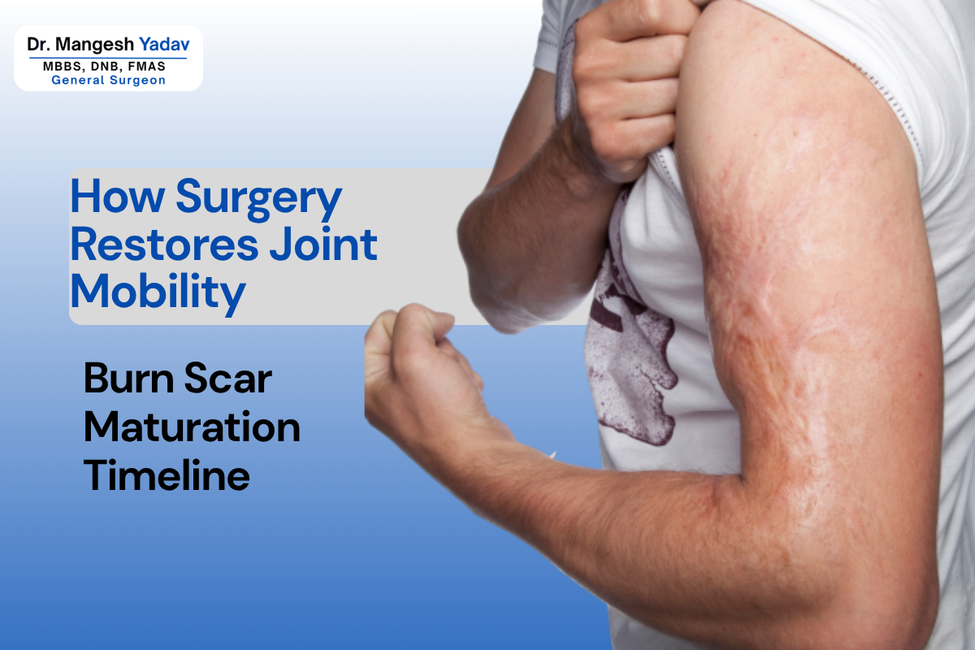
How Does Advanced Reconstructive Burn Surgery in Hadapsar Restore Joint Mobility Post-Burn Injuries?
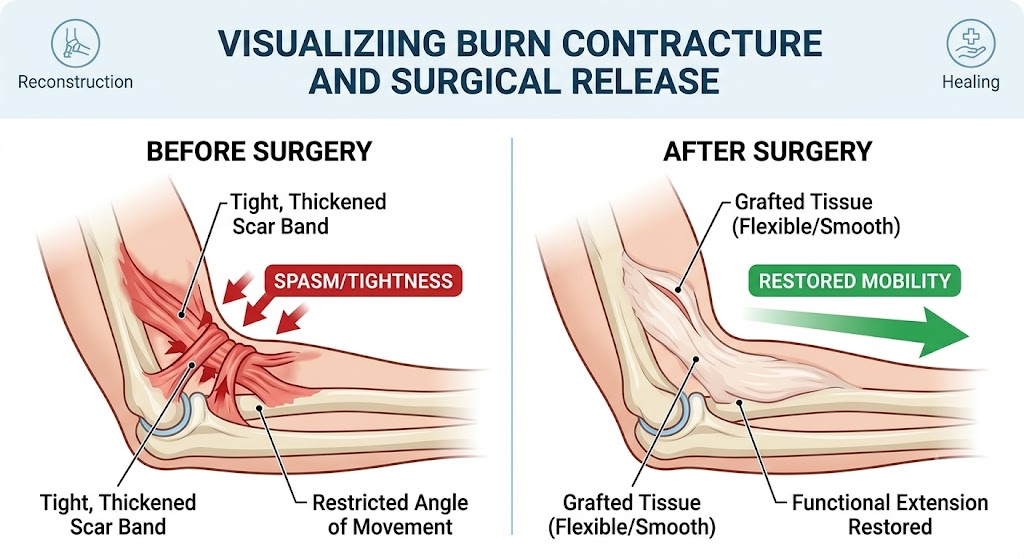
Reconstructive burn surgery restores joint mobility by surgically releasing the tight, contracted scar tissue that locks joints in restricted positions — and replacing it with healthy, flexible tissue through grafting or flap reconstruction. This is not cosmetic correction. It is functional restoration — giving patients back the ability to move, work, and live without restriction.
When a burn heals without reconstructive intervention, the scar tissue that forms is fundamentally different from normal skin. It lacks the elasticity, flexibility, and layered architecture of healthy tissue. As this scar tissue matures and contracts over months, it exerts progressive pulling force on underlying joints — fingers curl inward, elbows cannot fully extend, neck rotation is restricted, and knee movement becomes limited.
Understanding Burn Contractures
A burn contracture is the shortening and tightening of scar tissue across a joint that physically prevents full range of motion. Contractures can be:
- Mild — slight restriction, manageable with physiotherapy and splinting
- Moderate — significant restriction affecting daily function, requires surgical release
- Severe — joint locked in a fixed position, requires complex reconstruction with grafting or flaps
Left untreated, contractures worsen progressively. A joint that has 60% range of motion today may be at 30% in another year without intervention. Children are particularly vulnerable because their growing bodies stretch scar tissue that cannot keep pace — making early reconstructive planning critical.
Surgical Techniques Used in Reconstructive Burn Surgery in Hadapsar
Contracture Release Surgery The contracted scar band is precisely incised and divided, immediately releasing the joint from its restricted position. The resulting wound is then covered with a skin graft or local flap to allow the joint to remain in the corrected position during healing.
Z-Plasty and W-Plasty These geometric scar revision techniques reorient the direction of a linear scar — breaking the straight line that a contracting scar follows. By changing the scar’s direction, the pulling force across the joint is redistributed and eliminated. These techniques are particularly effective for neck, axilla (armpit), and digit contractures.
Tissue Expansion In cases where large areas of skin are needed for reconstruction, a silicone expander is placed under adjacent healthy skin and gradually inflated over weeks. The expanded skin is then used to reconstruct the burn-affected area — providing skin that matches the patient’s own colour, texture, and thickness perfectly.
According to the World Health Organization (WHO), burns are among the leading causes of disability worldwide, with contractures being the primary functional complication in survivors of deep burns. Early and planned reconstructive intervention is the most effective way to prevent permanent disability.
Post-Surgical Rehabilitation — The Critical Second Phase
Surgery releases the contracture. Physiotherapy maintains the release. Both are essential components of complete Reconstructive Burn Surgery in Hadapsar.
Post-operatively, patients receive a structured rehabilitation protocol:
- Customised splinting to maintain joints in the corrected position during healing
- Guided physiotherapy to progressively increase range of motion
- Compression garment therapy to control scar formation during recovery
- Scar massage techniques to improve tissue flexibility over time
For more information on surgical reconstruction and tissue repair, visit our dedicated page: Burns & Reconstructive Surgery in Pune.
What Is the Right Clinical Timeline to Plan Reconstructive Burn Surgery After Initial Burn Scar Maturation?
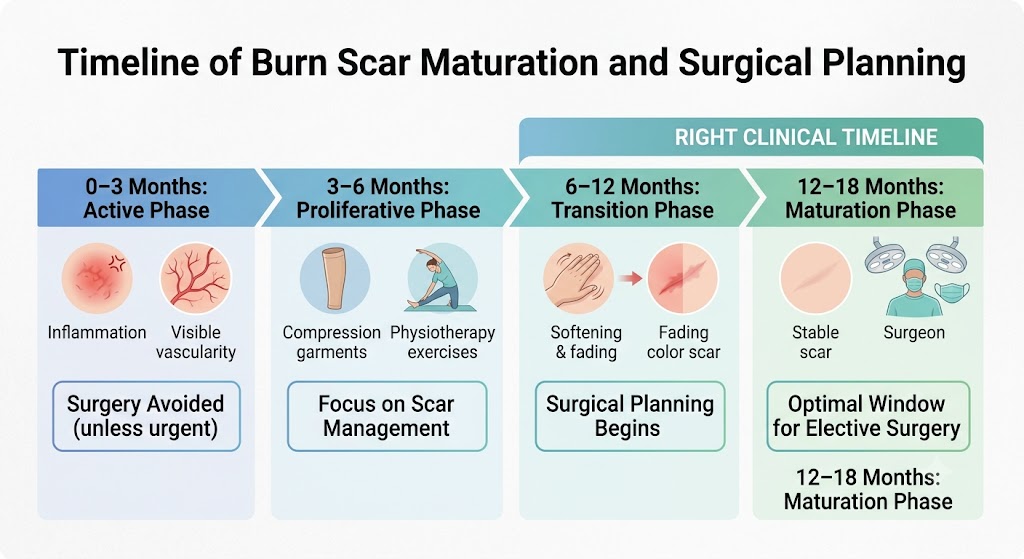
The optimal window for most reconstructive burn procedures is 12–18 months after the initial injury — once the scar has completed its maturation cycle and stabilised. However, this timeline is not rigid. Functional contractures that restrict movement, impair vision, or compromise breathing are addressed surgically as soon as the patient is medically stable — regardless of scar maturation.
Understanding Burn Scar Maturation
A fresh burn scar goes through a predictable biological timeline:
0–3 Months — Active Inflammatory Phase The scar is red, raised, tender, and highly vascular. It is changing rapidly. Surgery during this phase is avoided unless there is functional emergency — the scar is too unstable for reconstruction.
3–6 Months — Proliferative Phase Collagen production is at its peak. The scar may thicken into a hypertrophic (raised) form during this period. Compression garments, silicone sheets, and physiotherapy are the primary interventions at this stage.
6–12 Months — Transition Phase The scar begins to soften, fade, and flatten. The rate of change slows. This is the period when the surgeon begins detailed assessment and surgical planning.
12–18 Months — Maturation The scar has reached its final characteristics — colour, texture, flexibility, and contracture extent are now stable and accurately assessable. This is the optimal window for elective reconstructive procedures.
When to Operate Earlier — The Functional Emergency Rule
Despite the general 12–18 month guideline, certain situations demand earlier surgical intervention:
- Eyelid contracture (ectropion): Scar pulling the eyelid open exposes the cornea to drying and infection — requires urgent release to protect vision
- Oral commissure contracture: Tight scar limiting mouth opening severely restricts nutrition and oral hygiene — early release is essential
- Neck contracture: Significant neck flexion deformity in children interferes with airway development and head position
- Digital contractures in children: Growing bones cannot wait 18 months — contracture release is planned earlier to prevent skeletal deformity
- Non-healing wounds: Chronic open burn wounds require grafting at any stage to prevent ongoing infection and tissue loss
Dr. Mangesh Yadav assesses each patient individually — evaluating scar maturity, functional impact, patient age, and overall health — to determine the most appropriate surgical timing for their specific case.
Can Medical Laser Therapies Be Combined With Skin Grafting Procedures for Complex Burn Deformities?
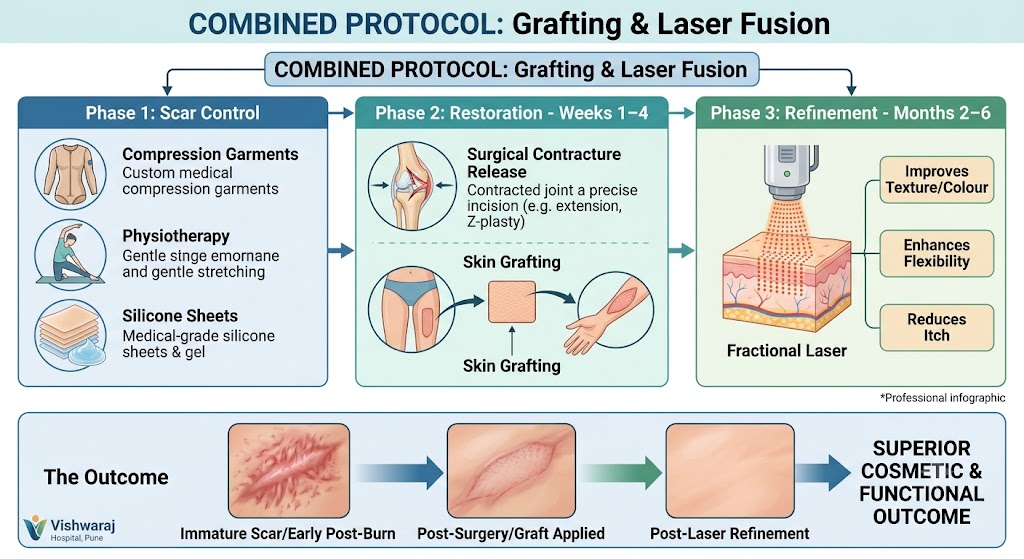
Yes — combining fractional laser therapy with skin grafting is one of the most powerful and modern approaches to complex burn scar reconstruction, delivering outcomes that neither technique achieves independently. This combination approach represents the current frontier of Reconstructive Burn Surgery in Hadapsar and is particularly effective for large surface area burns with both functional and aesthetic concerns.
What Skin Grafting Achieves
Skin grafting is the surgical transplantation of healthy skin from a donor site (usually the thigh, back, or scalp) to cover a burn-damaged area. There are two types:
Split-Thickness Skin Graft (STSG) The most commonly used graft — a thin layer of skin including the epidermis and part of the dermis is harvested and applied to the wound bed. STSGs heal the wound reliably and are suitable for large areas.
Full-Thickness Skin Graft (FTSG) A complete skin layer including full dermis is transplanted. FTSG provides better cosmetic and functional outcomes — more natural texture, better flexibility, and less contracture tendency — but is limited by donor site availability.
Flap Surgery When the wound bed cannot support a graft (poor vascularity, exposed bone or tendon), a flap procedure moves tissue with its own blood supply from an adjacent or distant donor site. Flaps provide superior coverage for complex defects.
What Laser Therapy Adds
Fractional CO2 laser and pulsed-dye laser therapy address what grafting alone cannot achieve:
- Scar texture improvement: Laser precisely resurfaces the graft surface, improving the match between grafted and surrounding skin
- Colour normalisation: Reduces hyperpigmentation and redness in mature burn scars
- Flexibility enhancement: Laser energy breaks down dense collagen bundles in the scar, improving elasticity
- Itch reduction: Laser treatment significantly reduces the chronic itch that many burn scar patients experience
- Pore and surface refinement: Improves overall cosmetic appearance of grafted areas
The National Institutes of Health (NIH) confirms that fractional laser treatment of burn scars and skin grafts significantly improves scar pliability, vascularity, pigmentation, and patient-reported quality of life scores — with a strong safety profile across all skin types.
The Combined Protocol — How It Works in Practice
A typical combined protocol for complex burn deformity:
Phase 1 (During Scar Maturation): Compression garments, silicone sheets, physiotherapy, and early laser sessions to control scar hypertrophy and maintain flexibility
Phase 2 (12–18 Months): Surgical contracture release with skin grafting or flap reconstruction to restore joint mobility and surface coverage
Phase 3 (Post-Surgical): Series of fractional laser sessions (typically 3–6 sessions at 6–8 week intervals) to refine graft texture, improve colour, and maximise final cosmetic and functional outcome
Phase 4 (Ongoing): Physiotherapy, compression garment continuation, and follow-up assessment at 6-month intervals
For patients with abdominal wall involvement from burn injuries or related post-surgical complications, our dedicated guide on Abdominal Pain & Lumps Treatment provides additional relevant information.
About Dr. Mangesh Yadav — Reconstructive Burn Surgery Specialist in Hadapsar Pune
Dr. Mangesh Yadav is a General, Laparoscopic & Robotic Surgeon with over 15 years of surgical experience at Vishwaraj Hospital, Pune Solapur Road, Loni Kalbhor, Pune. His reconstructive surgical practice encompasses burn contracture release, skin grafting, scar revision, and the management of complex post-burn deformities — with a patient-centred approach that prioritises both functional restoration and aesthetic improvement.
Qualifications: MBBS, DNB, FMAS — General, Laparoscopic & Robotic Surgeon Surgical Focus: Burns & reconstructive surgery, contracture release, skin grafting, scar revision, laparoscopic and robotic surgery Facility: Vishwaraj Hospital — equipped with advanced surgical systems, modern operating theatres, and comprehensive post-operative rehabilitation support
Every reconstructive case at Dr. Yadav’s practice begins with a thorough scar assessment, functional evaluation, and a personalised surgical plan. No two burn injuries are the same — and no two treatment plans should be either.
OPD: Mon–Sat: 3:00–5:00 PM & 7:00–8:30 PM | Sun: 10:30 AM–1:00 PM Appointment: +91-8220131599 | +91-9653331571
Why Choose Dr. Mangesh Yadav for Reconstructive Burn Surgery in Hadapsar?
1. Comprehensive Reconstructive Expertise From contracture release to complex flap surgery, Dr. Yadav’s surgical range covers the full spectrum of post-burn reconstruction — managed entirely under one specialist at one accessible location.
2. Combined Laser and Surgical Approach Dr. Yadav integrates fractional laser therapy with surgical reconstruction — delivering outcomes that surgery alone cannot achieve, particularly for large surface area burns and mature hypertrophic scars.
3. Individualised Surgical Timing No two burn injuries mature at the same rate. Dr. Yadav’s assessment-based surgical planning ensures every patient receives reconstruction at the optimal time for their specific scar stage and functional needs.
4. Rehabilitation-Integrated Care Surgery is only one part of reconstructive care. Dr. Yadav’s practice integrates post-operative physiotherapy planning, compression garment protocols, and long-term follow-up into every patient’s treatment journey.
5. What Makes Us Different Most surgical centres offer basic wound care. Reconstructive Burn Surgery in Hadapsar under Dr. Mangesh Yadav at Vishwaraj Hospital provides a clinically structured, multi-phase approach — combining surgical release, tissue reconstruction, laser refinement, and rehabilitation — that delivers the most complete functional and cosmetic recovery possible.
Frequently Asked Questions
How do I know if I need reconstructive burn surgery?
You need reconstructive evaluation if you have restricted joint movement due to burn scars, a non-healing burn wound, thick raised scars (keloids or hypertrophic scars) causing pain or functional limitation, or significant cosmetic deformity affecting confidence and quality of life. A single consultation with Dr. Yadav provides a complete assessment and clear treatment plan.
Is reconstructive burn surgery painful?
The procedure is performed under general anaesthesia — you feel nothing during surgery. Post-operative discomfort depends on the extent of reconstruction and is managed with prescribed pain relief. Most patients find post-operative recovery significantly more comfortable than the chronic discomfort of untreated contractures.
How many surgeries will I need?
This depends entirely on the extent and complexity of the burn injury. Some patients achieve excellent results with a single contracture release and grafting procedure. Others with large surface area burns or multiple joint involvement may require staged procedures. Dr. Yadav will outline the complete treatment plan during your initial consultation.
What is the recovery time after burn contracture release surgery?
Recovery varies by procedure. Skin graft donor sites heal in 2–3 weeks. The grafted recipient area requires 3–6 weeks of careful wound care and splinting. Full functional improvement — including physiotherapy milestones — typically takes 3–6 months.
Can old burn scars from years ago still be treated?
Yes. Mature burn scars — even those from injuries many years ago — can be significantly improved with contracture release, scar revision, and laser therapy. The results may not be identical to immediate post-burn reconstruction, but functional and cosmetic improvement is achievable in most cases.
At what age can children have reconstructive burn surgery?
Children are evaluated individually. Functional contractures — particularly those affecting the hands, face, or neck — are treated as early as medically safe, because growing bones cannot wait. Cosmetic scar revision is generally planned after growth is more complete. Dr. Yadav has extensive experience managing paediatric burn reconstruction.
Is skin grafting permanent?
Yes. Once a skin graft successfully takes (integrates with the wound bed), it becomes a permanent part of the body. The graft continues to live, grow, and function as normal skin — though it may have different colour or texture characteristics compared to surrounding skin, which laser therapy can subsequently improve.
Will I have scars at the donor site after skin grafting?
Yes — the donor site heals with a scar, though typically flat and less noticeable than the burn area. Donor sites are chosen in locations where the scar is easily hidden. With proper wound care and compression, donor site scars fade significantly over 12–18 months.
Does health insurance cover reconstructive burn surgery?
Coverage varies by insurance policy and the nature of the injury. Reconstructive procedures for functional restoration (contracture release, skin grafting for non-healing wounds) are typically covered. Purely cosmetic scar revision may not be. The billing team at Vishwaraj Hospital assists with insurance verification and claim support.
Reconstruction Is the Beginning of Your Next Chapter
Surviving a burn is a testament to extraordinary strength. But survival is not where your story ends — it is where your recovery begins. Reconstructive Burn Surgery in Hadapsar under Dr. Mangesh Yadav gives you the surgical expertise, the advanced technology, and the compassionate support to move from survival to genuine restoration.
Whether you need contracture release to move your fingers freely, skin grafting to close a wound that has not healed in months, or laser therapy to reclaim the appearance of your skin — your path forward is clear, safe, and achievable.
Book your private consultation today. Your recovery deserves expert hands.
Vishwaraj Hospital, Pune Solapur Road, Loni Kalbhor, Pune 412201 +91-8220131599 | +91-9653331571
Disclaimer: This blog is for informational purposes only. Please consult Dr. Mangesh Yadav for a personalised surgical assessment and treatment recommendations.
Need Help? We’ve Got You Covered
Contact Details
Clinic Address
153, Magarpatta Rd, Magarpatta, Hadapsar, Pune
Monday To Saturday: 03.00 PM to 05.00 PM / 07.00 PM to 08.30 PM
Sunday: 10.30 AM to 01.00 PM