
Severe Pain & Bleeding While Passing Stool? Get Advanced Anal Fissure Relief in Hadapsar
An anal fissure is a small tear or cut in the lining of the anal canal. It is one of the most painful anorectal conditions — causing sharp, burning pain during and after every bowel movement, along with bleeding. While acute fissures can heal with medication and dietary changes, chronic fissures lasting more than 6–8 weeks require advanced treatment.
Dr. Mangesh Yadav offers the most advanced Anal Fissure Treatment in Hadapsar Pune using Laser Sphincterotomy — a proven, minimally invasive procedure that delivers instant, permanent pain relief without any cuts or stitches, with same-day discharge.
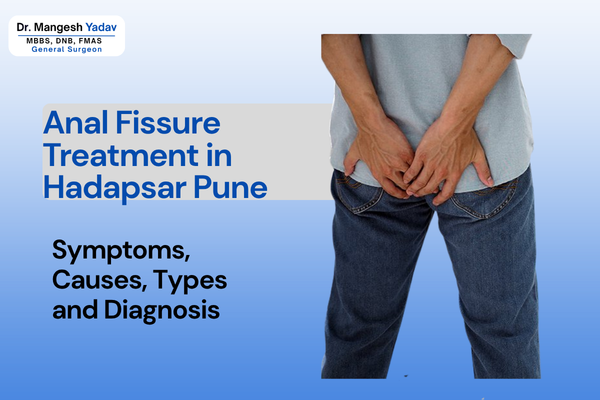
Symptoms of Anal Fissure
- Sharp, severe burning pain during and after passing stool
- Bright red bleeding on toilet paper or in the toilet bowl
- Visible tear or crack around the anal opening
- Itching or irritation in the anal area
- Sentinel pile — a small skin tag at the outer edge of the anus
- Hard, pellet-like stools due to fear of going to the toilet
- Spasm or tightness around the anus after bowel movements
Causes and Types of Anal Fissure
- Passing hard or large stools (chronic constipation)
- Chronic diarrhoea causing repeated irritation to the anal lining
- Spasm of the internal anal sphincter muscle (sphincter hypertonia)
- Straining during bowel movements
- Childbirth trauma in women
- Previous anorectal surgery
- Low-fiber diet and poor water intake
- Prolonged sitting — very common among Hadapsar’s IT professionals
- Excessive use of laxatives or ointments over a long period
Types of Anal Fissure
Acute Fissure A fresh tear, usually less than 6 weeks old. Often heals with conservative treatment — medications, sitz baths, and dietary changes.
Chronic Fissure A fissure that has not healed after 6–8 weeks. Usually develops a sentinel pile at the outer end. Medication alone rarely works. Laser Sphincterotomy is the most effective and permanent treatment for chronic fissures.
Diagnosis of Anal Fissure
- Detailed history of symptoms and duration
- Gentle visual inspection of the anal region — the fissure is usually visible externally
- Per rectal examination with local anaesthetic (lignocaine jelly) to reduce discomfort
- Proctoscopy is generally avoided as it is very painful in fissure cases; if absolutely needed, it is done under anaesthesia
- Assessment of sphincter tone and presence of sentinel pile
How Anal Fissure Works — Step by Step
When you choose Dr. Mangesh Yadav, here is exactly what the process looks like:
Step 1 — Private Consultation & Diagnosis A detailed review of your symptoms followed by a gentle clinical examination to confirm the diagnosis and classify the fissure as acute or chronic. Everything is completely confidential.
Step 2 — Pre-Procedure Preparation Minimal preparation is needed. Basic blood tests, a simple bowel prep, and nil by mouth for 6 hours before the procedure for anesthesia. No prior hospital admission required.
Step 3 — Laser Sphincterotomy (20–30 mins) Performed under local or short-duration general anesthesia. You feel nothing. The laser precisely releases the internal sphincter muscle, immediately relieving spasm and allowing the fissure to heal.
Step 4 — Same-Day Discharge After 1–2 hours of rest and a final check by Dr. Yadav, you are discharged the same day with medications and post-care instructions.
Step 5 — Follow-Up & Full Healing A follow-up visit within 7 days confirms healing. Most patients experience complete pain relief within 1–2 weeks.
Anal Fissure Who Needs Surgery?
Not every fissure requires surgery. Here is a simple guide:
Try medication first if:
- Your fissure is recent (less than 6 weeks old)
- Pain is manageable and not worsening
- There is no visible skin tag or sentinel pile
Consider Laser Sphincterotomy for Anal Fissure Treatment in Hadapsar Pune if:
- Pain has persisted for more than 6–8 weeks
- Medications, creams, and diet changes have not worked
- You have a visible skin tag or sentinel pile
- Bleeding continues with every bowel movement
- The pain is so severe that you are avoiding the toilet altogether — which makes the condition significantly worse
Anal Fissure Treatment Cost in Hadapsar Pune
| Treatment Component | Approximate Cost |
|---|---|
| Initial Consultation | ₹200 – ₹500 |
| Laser Sphincterotomy (all-inclusive) | ₹25,000 – ₹55,000 |
| Post-Care Medicines & Follow-Up | ₹1,000 – ₹2,500 |
What is included: Anesthesia, the laser procedure, same-day discharge, and follow-up visits are bundled into a single package. No hidden charges.
Why does cost vary? Depends on whether the fissure is acute or chronic, whether a sentinel pile needs to be removed alongside, and the type of anesthesia used.
Insurance & EMI: Most corporate Mediclaim and individual health insurance policies cover anal fissure surgery. The clinic team will verify your coverage at no charge. EMI options are available.
Recovery After Anal Fissure Treatment in Hadapsar Pune
Recovery after Laser Sphincterotomy is simple and fast:
- Day 1–2: Mild soreness around the treated area. Take prescribed medicines. Warm sitz baths 2–3 times a day provide significant comfort.
- Day 3–5: Pain noticeably reduces. Most patients report that even bowel movements are no longer agonising — a dramatic change from before treatment.
- Day 7: Follow-up visit. Healing is assessed. Most patients are largely pain-free at this stage.
- 2 Weeks: Complete healing in the majority of cases.
- Long-term: High-fiber diet, plenty of water, and avoiding straining prevent any future fissures. The Cleveland Clinic recommends consistent dietary fiber intake as the single most effective prevention strategy for anal fissures.
Why Choose Dr. Mangesh Yadav in Hadapsar?
Dr. Mangesh Yadav is a leading General, Laparoscopic & Robotic Surgeon with over 15 years of surgical experience, based at Noble Hospital & Research Centre, Hadapsar, Pune. He specialises in advanced anorectal procedures including Laser Sphincterotomy for Anal Fissure Treatment in Hadapsar Pune.
Dr. Yadav combines deep clinical expertise with state-of-the-art laser and robotic technology to deliver treatment that is precise, minimally painful, and built around each patient’s comfort and privacy.
All procedures are performed at Noble Hospital & Research Centre, equipped with:
- High-definition laparoscopic and laser surgical systems
- Robotic surgical platform (SSI Mantra 3.0)
- Modern sterile operating theatres
- Strict infection control and sterilization protocols
Surgical Experience at a Glance:
- 6,000+ piles treatments performed
- 4,000+ fistula treatments
- 5,000+ hernia surgeries
- 3,000+ gallbladder surgeries
Frequently Asked Questions
What does anal fissure pain feel like?
The pain is a sharp, intense burning sensation during a bowel movement, followed by throbbing or aching that can last 30 minutes to several hours. Many patients describe it as passing broken glass. It is one of the most painful anorectal conditions and significantly impacts daily quality of life.
Can an anal fissure heal without surgery?
Yes, acute fissures less than 6 weeks old often heal with stool softeners, dietary changes, sitz baths, and topical creams. However, chronic fissures — lasting more than 6–8 weeks — rarely heal on their own. For these cases, Laser Sphincterotomy for Anal Fissure Treatment in Hadapsar Pune is the most reliable and permanent solution.
What is the difference between a fissure and piles?
Piles (hemorrhoids) are swollen blood vessels inside or around the anus. A fissure is a tear or cut in the anal lining. Both cause pain and bleeding but are different conditions with different treatments. It is also possible to have both at the same time, which is why a proper clinical examination is important before starting any treatment.
Is Laser Sphincterotomy painful?
No. The procedure is done under anaesthesia, so you feel nothing during the surgery. Post-procedure discomfort is mild and short-lived. Most patients are surprised to find that their first bowel movement after surgery is less painful than what they experienced from the fissure itself.
How long does the procedure take?
The Laser Sphincterotomy itself takes 20–30 minutes. Including preparation and the post-procedure rest period, plan to be at the clinic for approximately 3–4 hours before being discharged home the same day.
Is there any risk of incontinence after sphincterotomy?
There is a very small, rare risk of temporary mild gas incontinence after the procedure. This is almost always short-term and resolves on its own. Dr. Yadav will explain all risks in detail during the consultation so you can make a fully informed decision.
How soon can I return to work?
Office and desk job workers typically return within 2–3 days. Those with physically demanding work may need 5–7 days of rest. This is significantly faster than recovery from traditional open surgery.
How many sittings are needed for laser fissure treatment?
Laser Sphincterotomy is a single-session procedure. One sitting is sufficient for complete treatment in the vast majority of cases. There is no need for multiple visits or repeat procedures.
Will the fissure return after laser treatment?
The long-term success rate of Laser Sphincterotomy is over 90%. Recurrence is rare. Maintaining a high-fiber diet, adequate hydration, and not ignoring the urge to pass stool are the most important steps to prevent any future fissures.
Conclusion : Anal Fissure Relief Starts Here
Anal fissure pain is real, severe, and completely treatable. You do not have to plan your day around toilet visits or live with the fear of every bowel movement. Anal Fissure with Laser Sphincterotomy under Dr. Mangesh Yadav offers permanent relief — no cuts, no stitches, same-day discharge, and complete privacy.
Take the first step today. Your pain ends here.
153, Magarpatta Road, Hadapsar, Pune +91-8220131599 drmangeshyadav.com
Need Help? We’ve Got You Covered
Contact Details
Clinic Address
153, Magarpatta Rd, Magarpatta, Hadapsar, Pune
Monday To Saturday: 03.00 PM to 05.00 PM / 07.00 PM to 08.30 PM
Sunday: 10.30 AM to 01.00 PM
Book An Appointment
Lorem ipsum dolor sit amet, consectetur adipiscing elit. Ut elit tellus, luctus nec ullamcorper mattis, pulvinar dapibus leo.